Hole
Source file: hole.htm
The Hole group on the Home ribbon contains tools that allow you to view hole attributes and properties, as well as create hole intervals.

Hole Tabular View
Use the  Hole Tabular View to view a specific set of hole attributes depending on the preset you select. The tool also allows you to export this data as a PDF or CSV file.
To enter the Hole Tabular View panel, follow these steps:
-
Select the required holes in the view window.
-
On the Home ribbon, in the Hole group, select
Hole Tabular View.
The Hole Tabular View panel will appear. The panel contains two column fields and one table that allow you to customise and view the required hole attributes.Tip
After selecting the required holes, you can also enter the Hole Tabular View panel the following ways:Using the keyboard shortcut Ctrl+T.
Right-clicking in the view window and selecting
Hole Tabular View from the context menu.
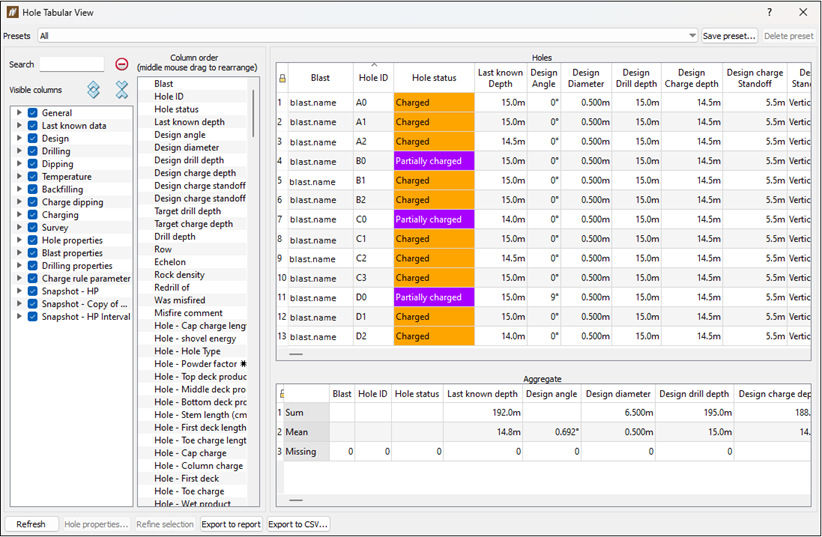
Viewing hole data
To view hole data using the hole tabular view, follow these steps:
-
Select a set of holes in the view window.
-
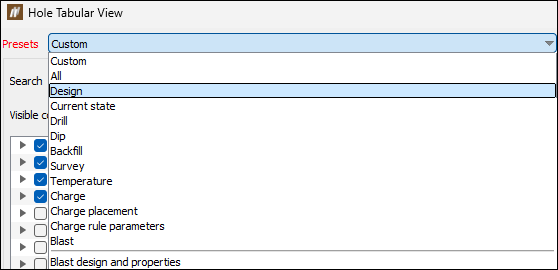
Enter the Hole Tabular View panel and select the required preset from the Presets drop-down.
Note: A preset is a specific set and order of columns that is displayed in the Hole table.
-
Optionally, edit the displayed attributes by completing the following steps:
-
In the Visible columns field, click the
 button corresponding to the required category to view all of the attributes the category contains.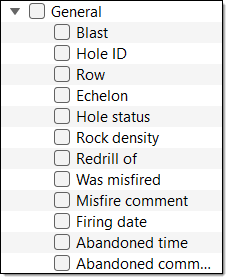
Tip: Use the
 button to expand all categories at once. To close this detailed attribute view of all categories, click the
  button.
Note: Any snapshots of the selected blast are also listed as categories and contain the related snapshot hole attributes.
-
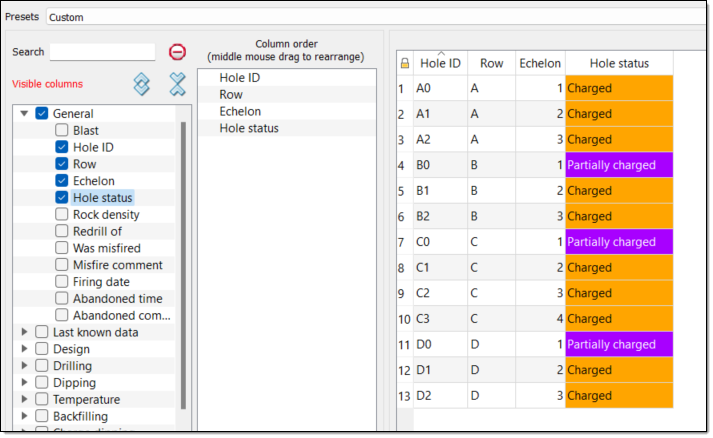
In the Visible columns field, select the checkboxes of the attributes you wish to view, or clear the checkboxes of the attributes you wish to hide.
 Note
NoteYou can also specify the hole attributes you wish to view in either of the following ways:
-
Select the category checkbox to add every attribute in that category to the Columns order field and Holes table. You can also clear any checkboxes corresponding to the attributes you do not wish to view.
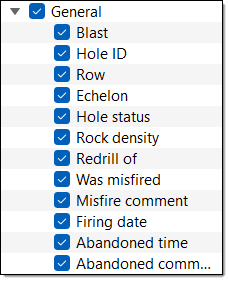
-
Enter an attribute or category name into the Search field. BlastLogic will present the results that match the search in the Visible columns field. Select the checkboxes of the results you wish to view or clear the checkboxes of the results you wish to hide.
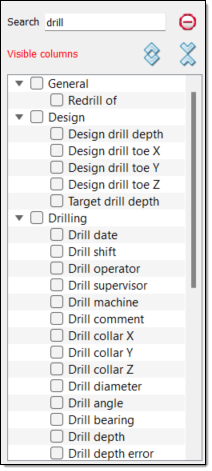
-
-
Optionally, reorder the attributes in the Column order field by dragging the attributes to the desired locations using the middle mouse button.
TipRight-click on an attribute in the Column order to view the following context menu options:
-
Select column. Select to view the attribute column in the Holes table.
-
 Remove column. Select to remove the attribute from the Holes table.
-
-
You can interact with the Hole Tabular View panel as follows:
To highlight a hole in the view window, select the row corresponding to that hole in the Holes table.
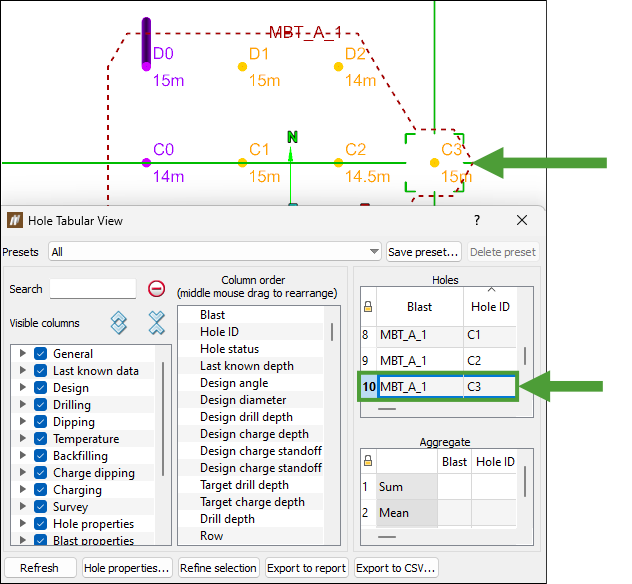
To view the properties of a certain hole, select that hole in the Holes table and click Hole properties....
To view the hole attributes of a different blast, select the required blast in the project explorer. The information on holes from the selected blast will appear in the panel.
To further refine the selection of holes, select the desired holes in the panel with Ctrl+click or Shift+click, then click Refine selection. BlastLogic will reduce the number of rows to the selection made.
To export the data as a PDF file, click Export to report.
To export the data as a CSV file, click Export to CSV....
Creating a custom preset
Custom presets allow you to save the columns present in the Hole table and the order they appear in. To create a custom preset, follow these steps:
-
Select a set of holes in the view window.
-
Enter the Hole Tabular View panel, go to the Presets drop-down and select Custom.
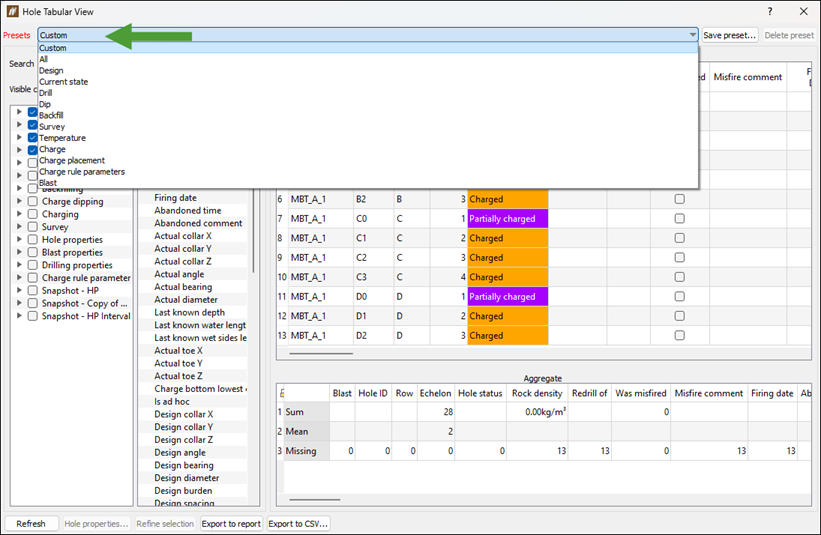
-
Edit the appearance and order of the columns in the Holes table.
 Expand for more information on editing the appearance and order of the columns.
To edit the columns in the Hole table and the order they appear in, follow these steps:
-
In the Visible columns field, click the
 button corresponding to the required category to view all of the attributes the category contains.
Tip: Use the
button to expand all categories at once. To close this detailed attribute view of all categories, click the button.Note: Any snapshots of the selected blast are also listed as categories and contain the related snapshot hole attributes.
-
In the Visible columns field, select the checkboxes of the attributes you wish to view. BlastLogic will add the selected attributes to the Column order field and Holes table, in the order that you selected the attributes .
NoteYou can also specify the hole attributes you wish to view in either of the following ways:
-
Select the category checkbox to add every attribute in that category to the Columns order field and Holes table. You can also clear any checkboxes of the attributes you do not wish to view.
-
Enter an attribute or category name into the Search field. BlastLogic will present the results that match the search in the Visible columns field. Select the checkboxes of the results you wish to view.
-
-
Add any other attributes to the Column order field and Holes table by selecting the checkboxes of the desired categories and attributes.
-
Optionally, reorder the attributes in the Column order field by dragging the attributes to the desired locations using the middle mouse button.
TipRight-click on an attribute in the Column order column to view the following context menu options:
-
Select column. Select to view the attribute column in the Holes table.
-
Remove column. Select to remove the attribute from the Holes table.
-
-
-
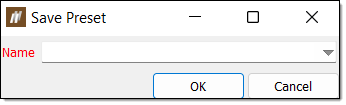
Click Save preset.... The Save Preset panel will appear.
-
Enter a preset name using the Name field or drop-down menu.
-
Click OK. The preset will now appear in the Preset drop-down.
Note: To delete a preset you no longer need, select it from the Presets drop-down and click Delete preset.
 Create Pattern
Use the Create Pattern tool to define a grouping of holes, known as a pattern.
To create a pattern, follow these steps:
-
Click on a blast in the project explorer or select the blast in the view window.
-
On the Home ribbon, in Hole group, select
Create Pattern. The Create Pattern panel will appear. By default, BlastLogic fills the Name field with the name of the selected blast.
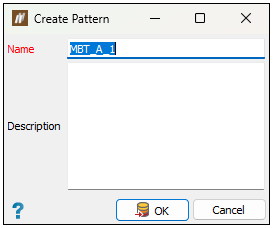
Note: Optionally, enter a different name into the Name field and enter a description into the Description field.
-
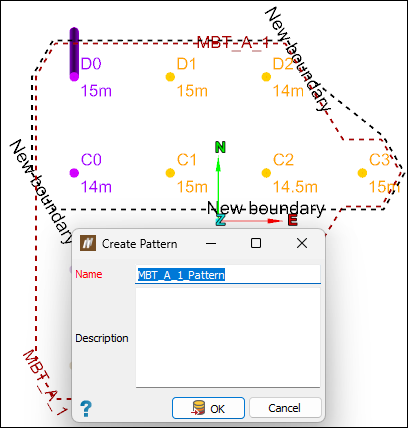
Select the holes in the view window that you wish to include in the pattern. BlastLogic will include them in the view window within an area named New boundary.
-
Click OK. BlastLogic will save the pattern to the
 Patterns container located in the parent blast container in the project explorer.
Note: To edit a pattern, see the steps in the Edit section of the Pattern on the Context Sensitive Ribbons page.
 Edit Intervals
The Edit Intervals tool allows you to add sections to a hole. You will need both an upper and lower surface to define the interval within the hole.
Adding hole intervals from surfaces
To add hole intervals to a hole using surfaces, follow these steps:
- Select the desired holes in the view window or project explorer.
-
On the Home ribbon, in the Hole group, select
Edit Intervals.
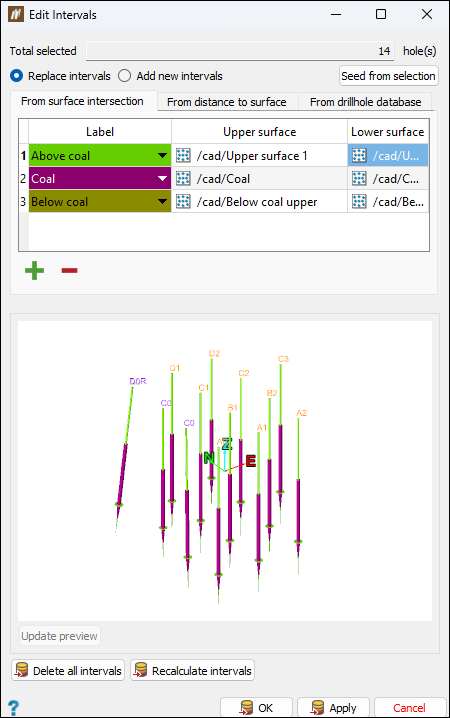
The Edit Intervals panel will appear. Ensure the From surface intersection tab is open.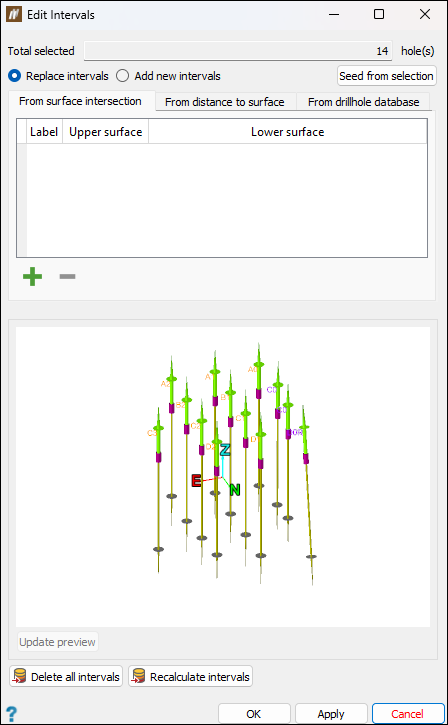
-
Click
 to add a label. Repeat this until the desired number of labels appear in the table.
 -
Select an interval label. By default, BlastLogic sets the interval label to the first interval that is listed in Interval labels (Home ribbon > Setup group >
 Site). You can change the interval by clicking on the label cell drop-down and selecting the desired interval label.
 -
Specify the upper and lower surfaces. You can specify these surfaces in the following ways:
-
Select the cell you wish to assign a surface to and enter the surface location. For example, surfaces are typically found in the
cadcontainer with the location/cad/<surface name>. -
Drag the surface from the
cadcontainer in the project explorer or from the view window, into the desired cell, using the middle mouse button.
Note: Only one surface is required. If you only select one surface, BlastLogic will create an unbounded interval for the second surface. To create a surface, see the steps in Surfaces.
Note
If you are in the Replace intervals mode and click OK without specifying any surfaces, the specified interval label of all intervals will be cleared. A dialog window will appear for you to confirm this operation.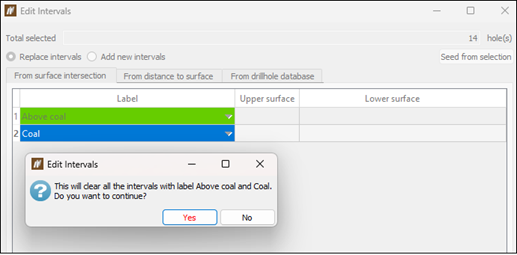
Tip: You can add or remove intervals by clicking
 or
or  respectively.
 -
-
Select the hole interval update method. You can select either Replace intervals or Add to existing intervals.
-
Select Update Preview to view the hole intervals.
- Optionally, you can run the following commands:
Delete all intervals: This tool clears all of the existing intervals on the selected holes.
Recalculate intervals: If changes are made to the holes or surfaces, select this tool to update the intervals.
-
Click OK or Apply.
Note: If the hole geometry changes, any attached surface will automatically recalculate its intersections with holes.
Adding hole intervals from distance to surface
Intervals can be defined by the regions of a hole within a specified distance from a surface. Such intervals can help identify the sections of holes that are too close to a highwall or to provide offsets from coal seams. These intervals can then be used in charge rules to avoid charging in these regions.
Follow these steps to add hole intervals from distance to surface:
-
Select holes in the view.
-
Go to the Geometry ribbon > Surfaces group and select
 Surface from Holes.
 -
In the Surface from Holes panel, select Drill depth from the Colouring metric field and click OK.
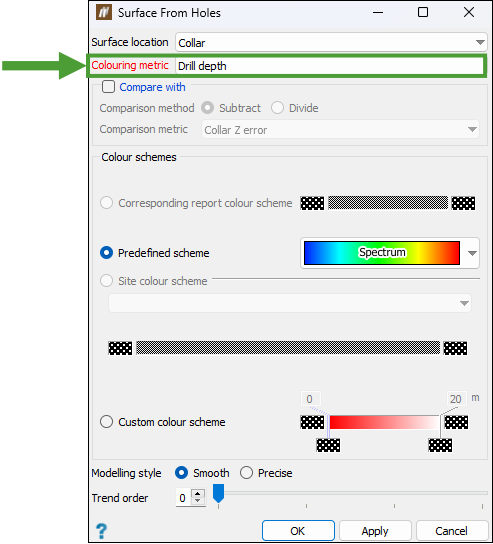
See Surface From Holes for more information on creating surfaces from holes.
-
Select the holes in your view and go to the Home ribbon > Hole group and select
Edit Intervals. -
Select the From distance to surface tab and click
 to add a surface.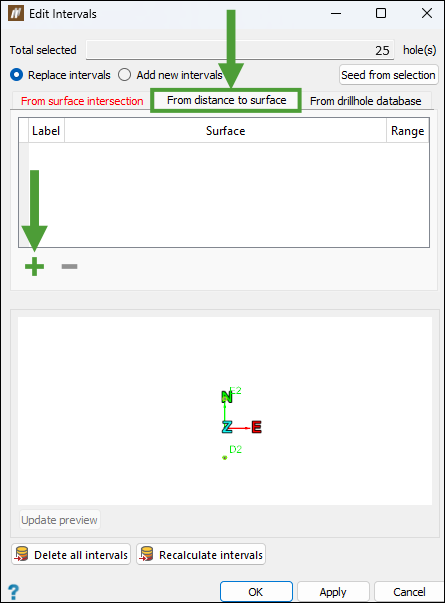
-
Specify the Label by selecting the required option from the drop-down menu.
-
Middle-mouse click on the surface you have created in the cad container and drag it to the Surface field in the Edit Intervals window.
-
Define the Range.
-
Repeat the above steps to add more intervals and click OK or Apply to confirm.
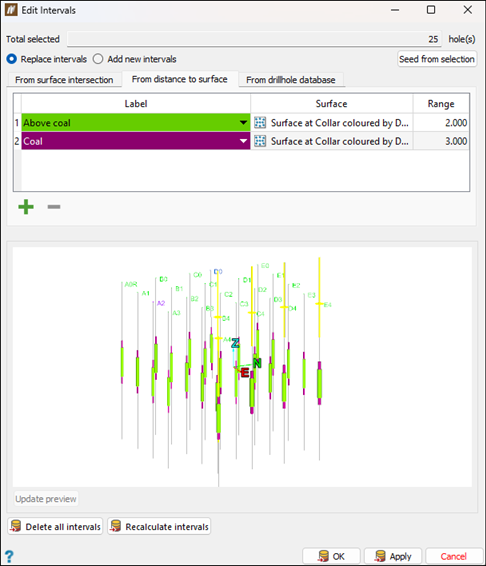
Note: If the hole geometry changes, any attached surface will automatically recalculate its intersections with holes.
Note
Set the view mode to display intervals by going to the View context sensitive ribbon and selecting Intervals or selecting Intervals from the
  Visualisation drop-down on the toolbar.
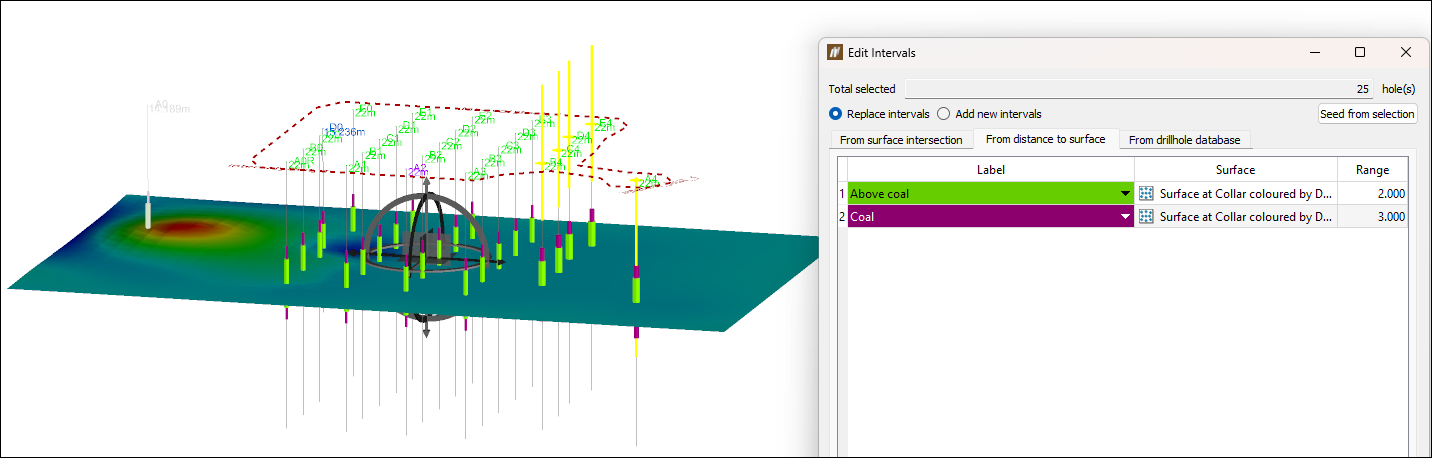 Tip
TipYou can reopen the intervals created for a given blast in the following way:
-
Go to the Home ribbon > Hole group and select
Edit Intervals. -
Go to the From distance to surface tab.
-
Select a blast or holes in the project explorer or in the view window.
-
Click Seed from selection.
The created intervals will be loaded to the Edit Intervals panel.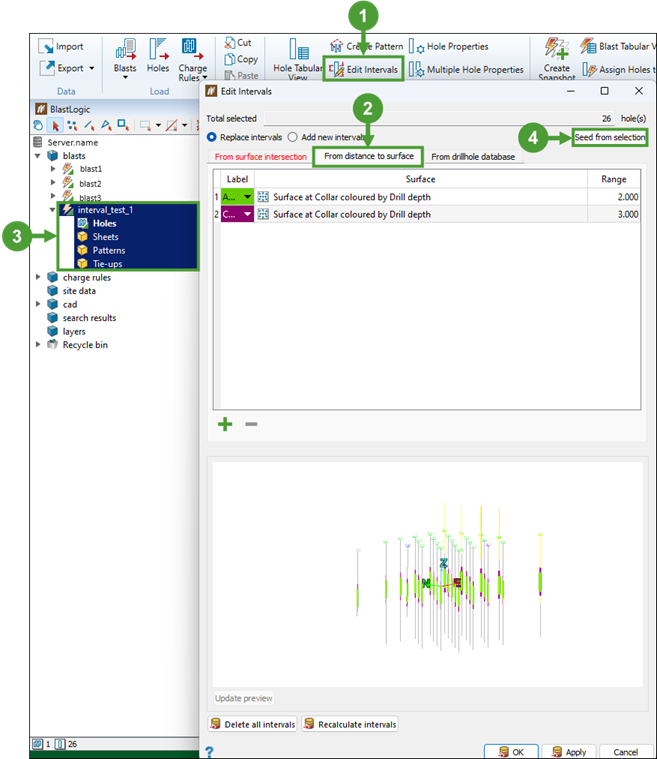
Important: Once a surface has been attached to holes (for example, when the holes are applied to an interval), it is then published and cannot be edited anymore.
-
Adding hole intervals from drillhole database
To add hole intervals using the drillhole database tab, follow these steps:
- Select the desired holes in the view window or project explorer.
-
On the Home ribbon, in the Hole group, select
Edit Intervals.
The Edit Intervals panel will appear. - Select the From drillhole database tab.
-
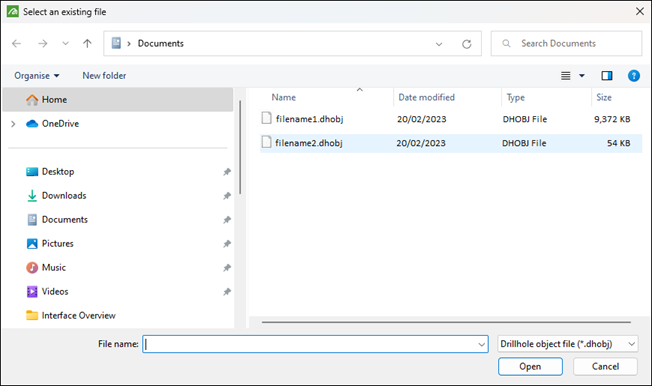
Click
 . The file explorer will open.
 -
Select a drillhole database object file (
.dhobj) and click Open.TipYou can create a drillhole object file by exporting a blast with drill measurements into Maptek GeologyCore. Use the Create Intervals from Downhole tool to add intervals in GeologyCore. The object must then be exported as a drillhole object file such that it can then be imported into BlastLogic. For more information on this process, see Maptek GeologyCore help documentation.
-
Click OK or Apply to confirm the changes.
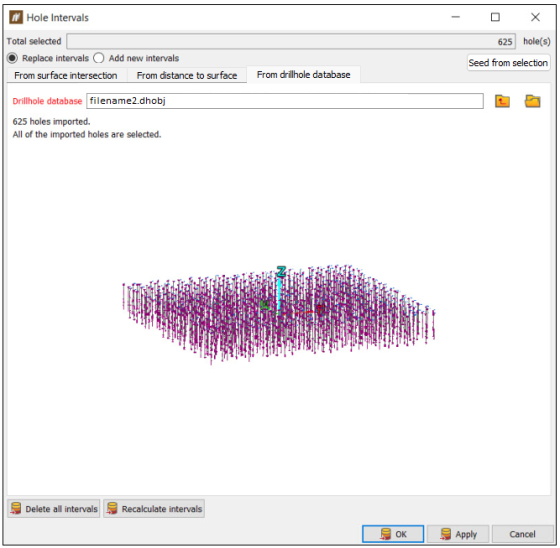
You can view the intervals by selecting the Hole Properties tool in the Hole group, and navigating to Decks and Intervals > Intervals.
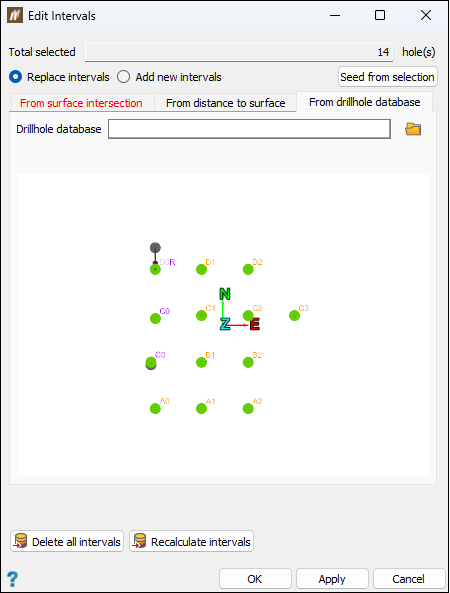
BlastLogic displays a preview of the blast with the updated hole intervals.
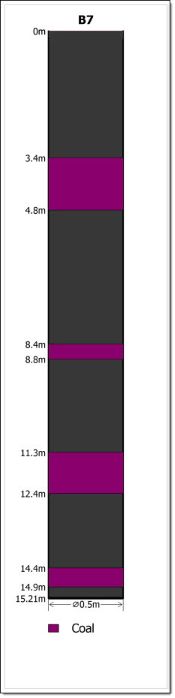
 Hole Properties
Use the Hole Properties tool to view and edit the properties of a single hole.
To view the properties of a hole, follow these steps:
-
Select the required hole in the view window.
-
On the Home ribbon, in the Hole group, select
Hole Properties. Tip
You can also enter the Hole Properties panel the following ways:Selecting the required hole and using the keyboard shortcut Ctrl+H.
Right-clicking on the hole in the view window and selecting
Properties of <hole name>... from the context menu.
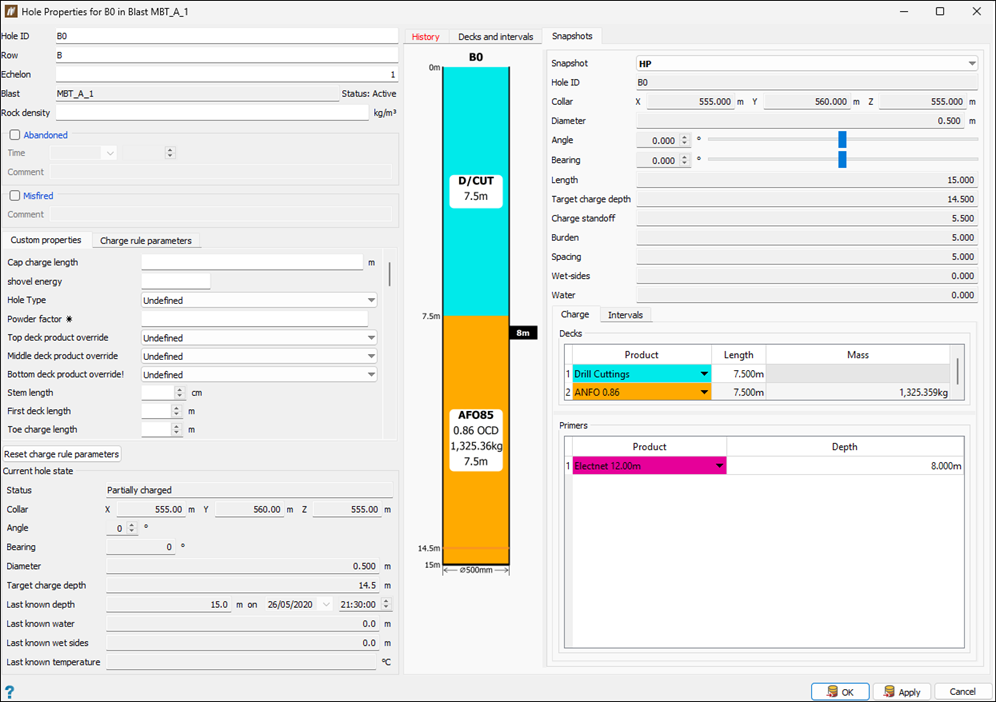
The Hole Properties panel will appear. This panel has the following sections:
- The left-hand side of the panel displays the current information about the hole, including the custom properties and charge rule parameters that have been specified for it.
- The right-hand side of the panel shows the history of the hole, the current decks and intervals, and any snapshots that were created for that hole. For details, see the Viewing hole history, Decks and intervals, and Snapshots below.
Selecting from multiple holes
You can select multiple holes in the view window, enter the Hole Properties panel and switch between the selected holes using the Selected hole drop-down menu.
Note: This drop-down menu will only appear when you select multiple holes.
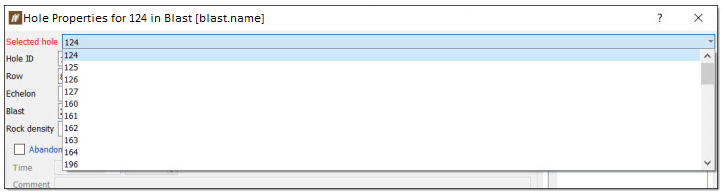
See also: Multiple Hole Properties
Viewing hole history
Click on a row in the history table to display the details of that entry.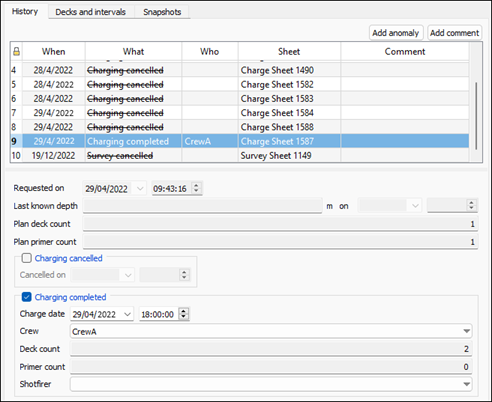
You can also leave a comment or report an anomaly in the records of each hole. To do so, click Add comment or Add anomaly at the top of the hole history table and enter the required information.
| Adding a comment | Adding an anomaly |
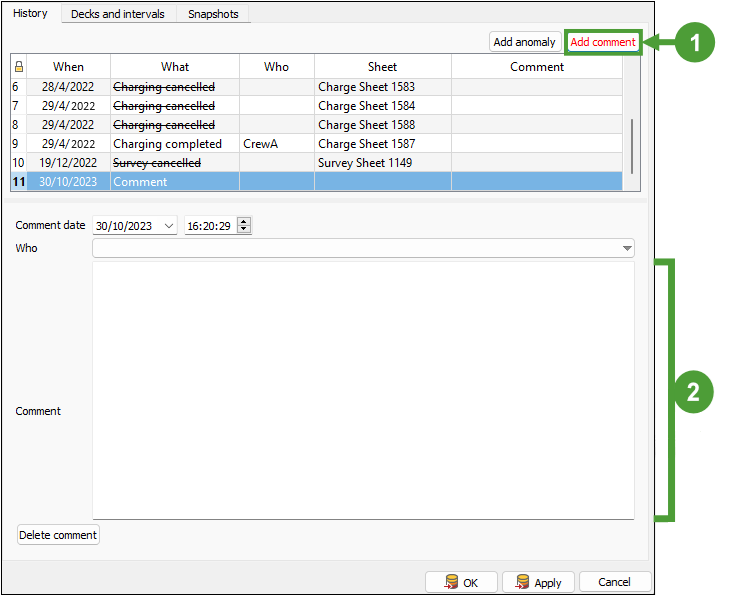
|
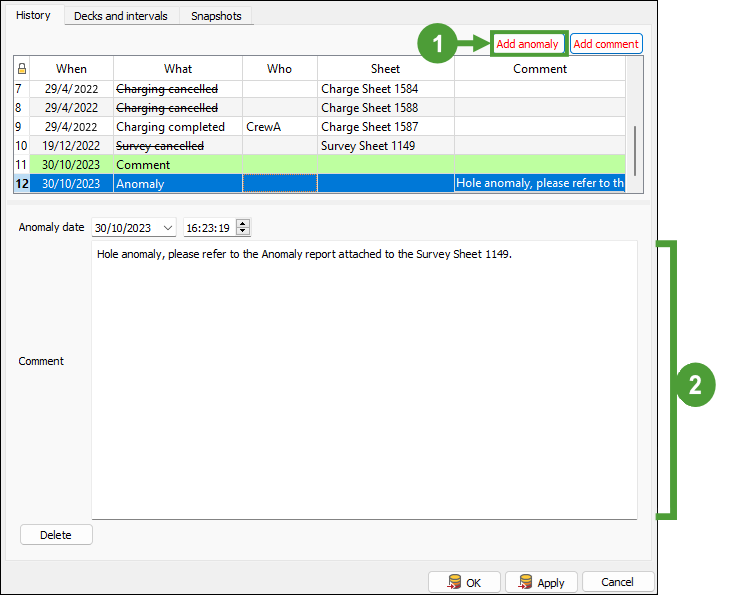
|
Note: To delete a comment or anomaly entry that is no longer required, select it in the table and click Delete comment or Delete, respectively.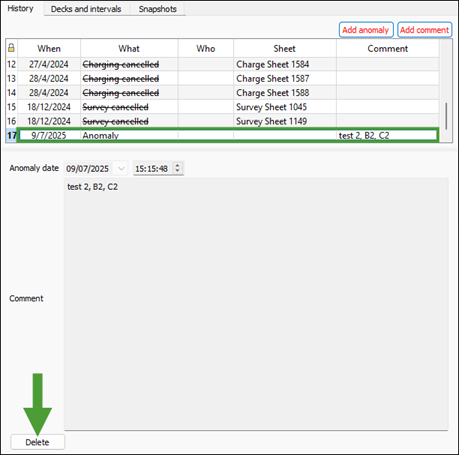
The reported hole anomaly will also be noted in your Blast Summary Report under the Anomalies tab.
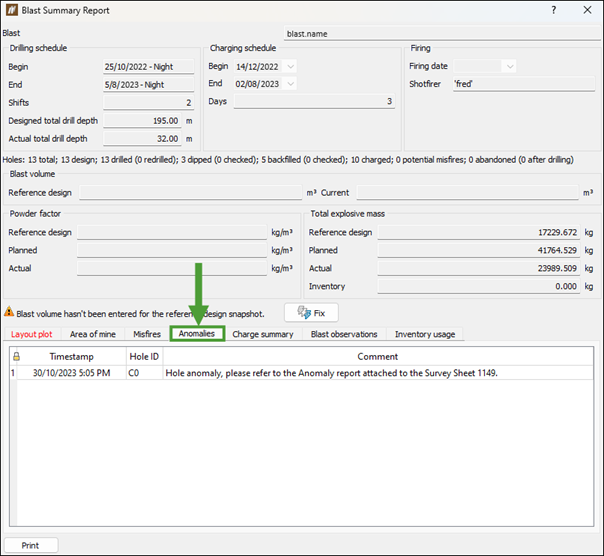
See Blast Summary Report for more information.
Decks and intervals
The Decks and intervals tab displays the planned and actual charge decks, the intervals for the selected hole and any associated drill measurements. This tab contains the following five subtabs:
-
Charge plan
In the Charge plan subtab, you can open the associated rule to view or edit it. The associated charge rule may be reapplied to update the table if you make any changes to the design of the hole or charge rule. BlastLogic also displays the hole charge decks and primers in the embedded view window next to the table.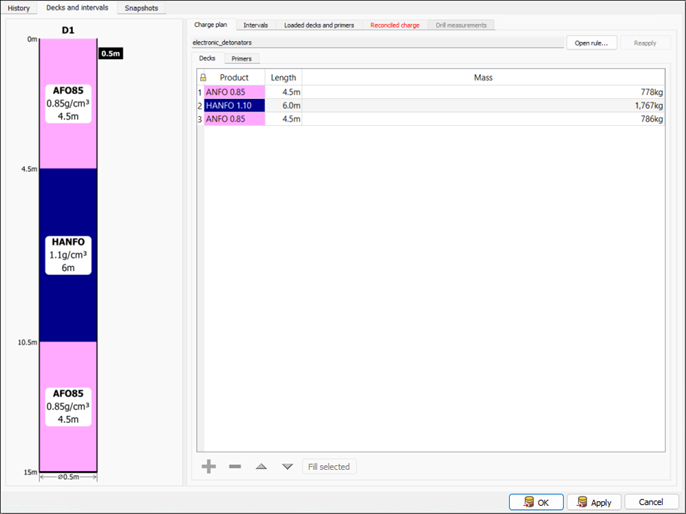
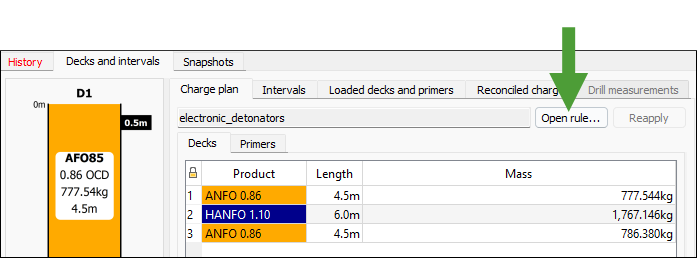
Follow these steps to view or edit the charge rule associated with the selected hole:
-
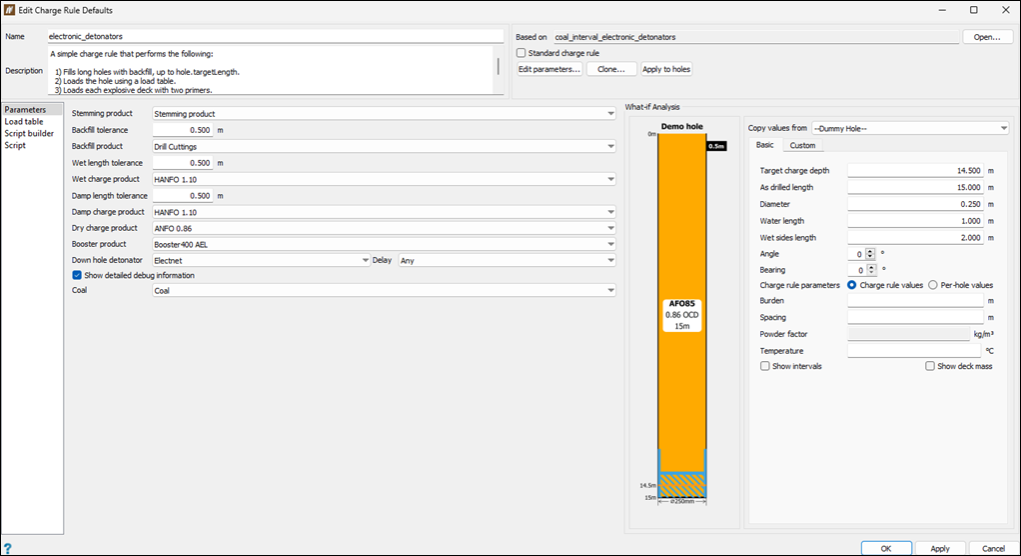
In the Decks and intervals tab > Charge plan subtab of the Hole Property panel, click the Open rule... button.
-
In the Edit Charge Rule Defaults panel, edit the required parameters (see Edit Charge Rule for more information).
-
Click OK or Apply to save your changes.
See also: Create Charge Rule
-
-
Intervals
The Intervals subtab shows all the intervals currently defined on the hole. Selecting an individual interval label from the drop-down list allows you to add, edit or remove the intervals with that label.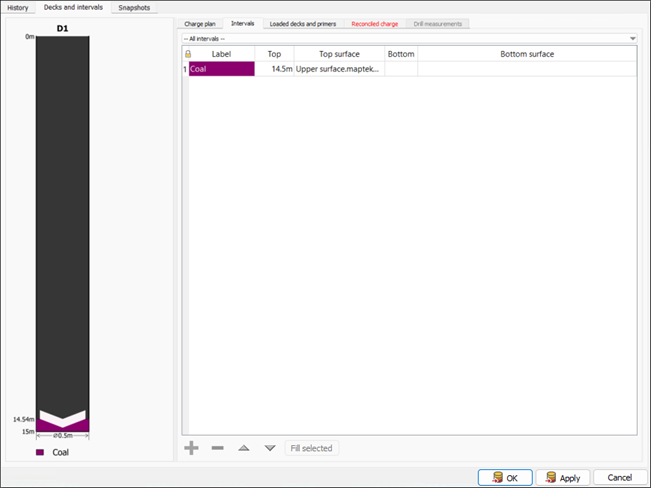
-
Loaded primers and decks
The Loaded decks and primers subtab shows events captured through the BlastLogic Tablet application. The events displayed here are read-only.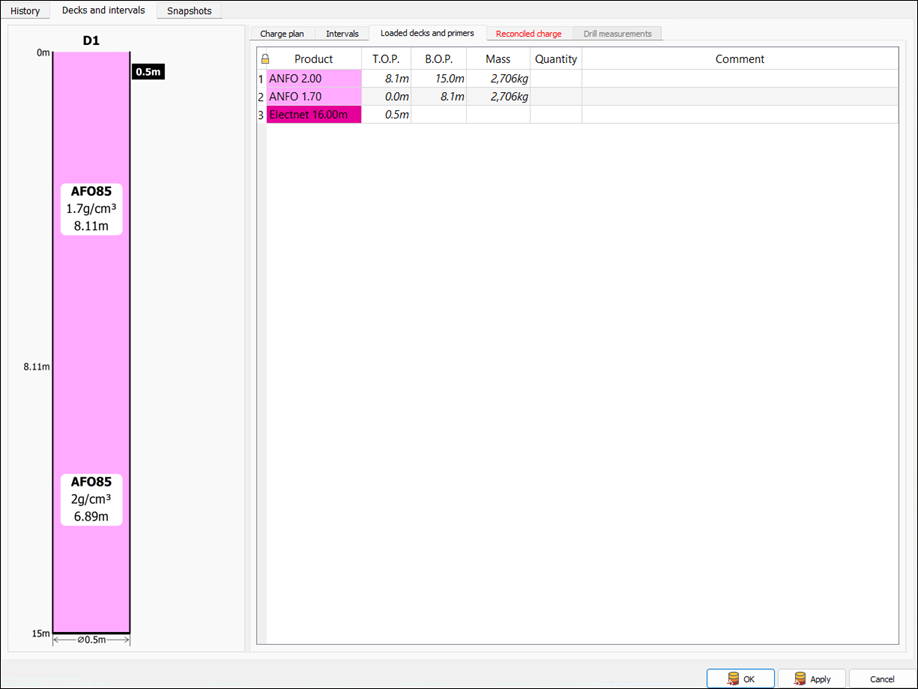
-
Reconciled charge
The Reconciled charge subtab shows the reconciled charging decks and primers of the hole in a read-only format.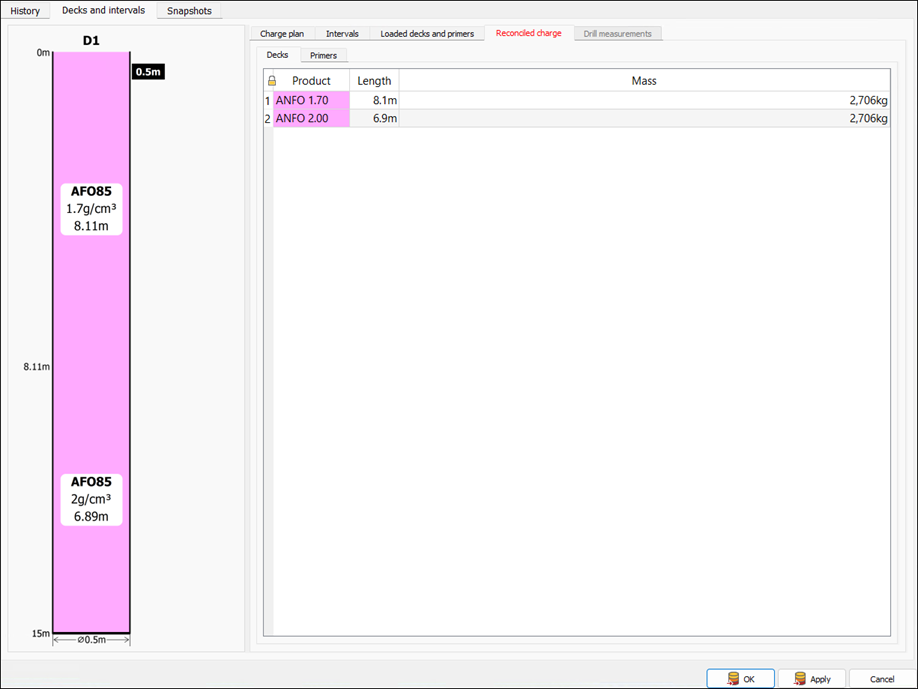
-
Drill measurements
The Drill measurements subtab displays the drill measurement properties. These measurements are added by the BlastLogic Integration Service, but you can also add them manually the following ways:-
Via the
 Validate Drilling panel.
 -
By going to the Drilling ribbon > Drill Measurements group, and selecting
 Import from CSV.
 -
By going to the Home ribbon > Data group, and selecting
 Import.
For more information, see Validation and Managing Data.
You can set the types of properties in the Drill measurements tab of the Site Setup panel. To open this panel, navigate to the Home ribbon, and in the Setup group select
Site.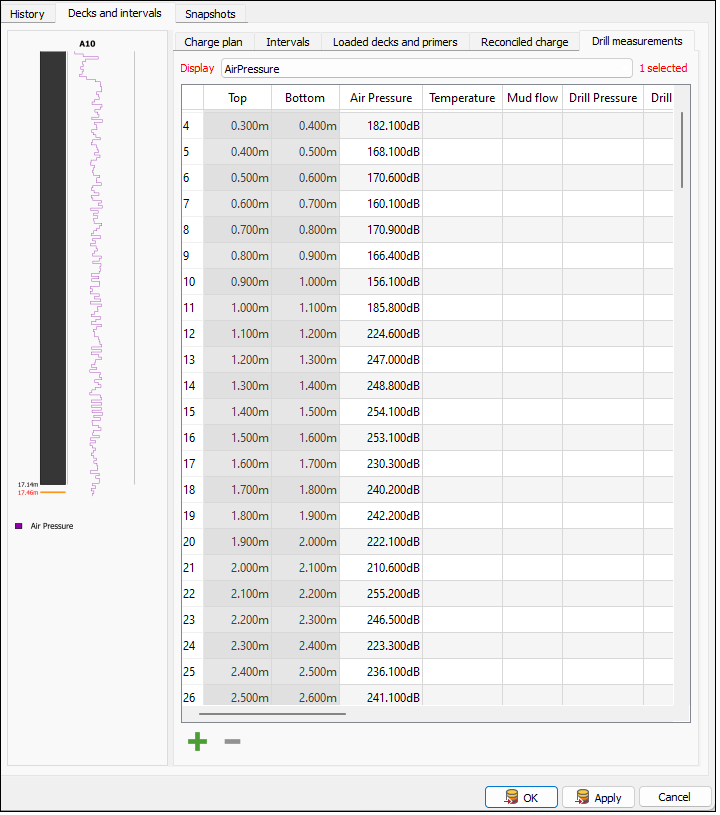
-
Snapshots
The Snapshots subtab displays the snapshot information of the selected hole. You can select the desired snapshot using the Snapshot drop-down. The tab also provides the following subtabs:
-
Charge
The Charge subtab contains the sections Decks and Primers that display tables categorising the deck and primer information respectively for the selected hole.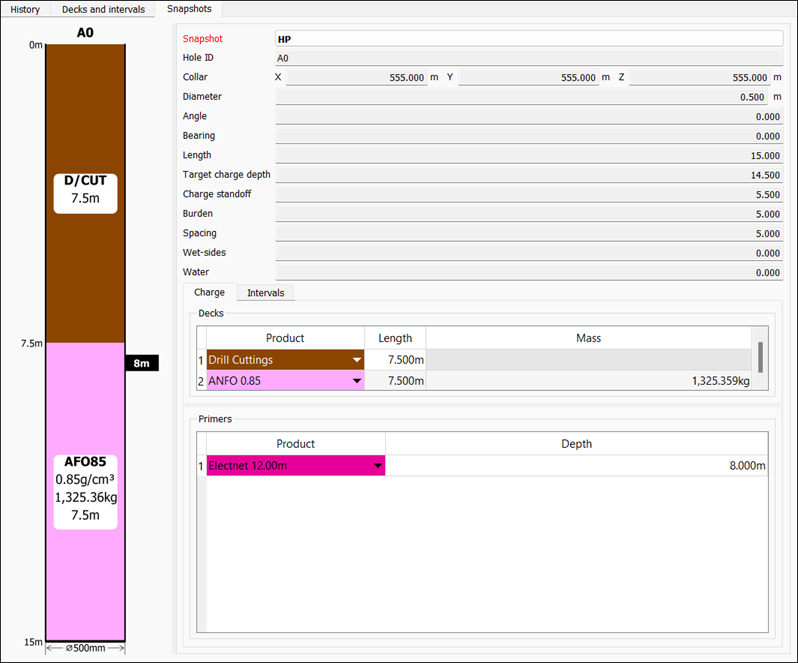
-
Intervals
The Intervals subtab contains an interval type drop-down and a table. By default, BlastLogic displays all of the intervals, however you can specify an interval type using the drop-down list. The table presents the interval type specified in the drop-down.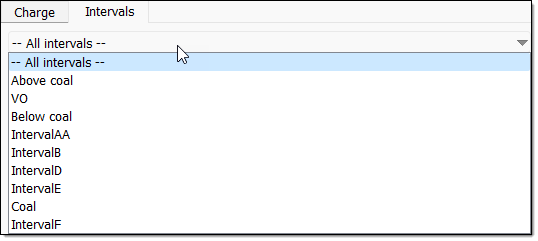
 Multiple Hole Properties
Use the Multiple Hole Properties tool to view and edit the properties of multiple holes that you selected, as well as to add comments and record any observed anomalies. The Multiple Hole Properties panel consists of the following tabs:
To enter the Multiple Hole Properties panel, follow these steps:
-
Select the required holes in the view window.
-
On the Home ribbon, in the Hole group, select
Multiple Hole Properties.
The Multiple Hole Properties panel will appear with the Design tab open by default.Tip
After selecting the required holes, you can also enter the Multiple Hole Properties panel the following ways:Using the keyboard shortcut Ctrl+Shift+H.
Right-clicking in the view window and selecting
Multiple Hole Properties from the context menu.
Design
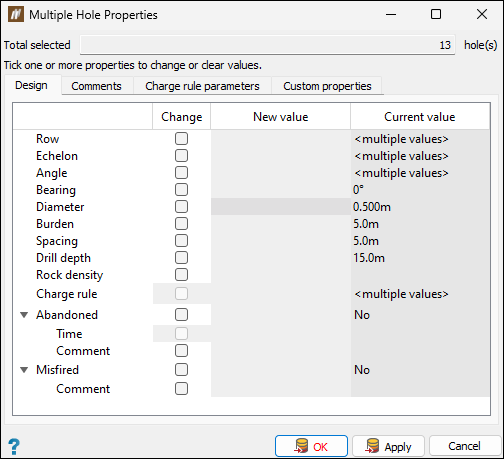
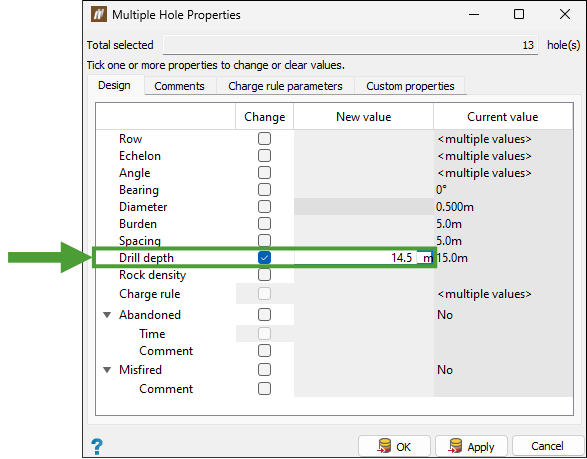
Use the Design tab to view and edit the main properties of multiple holes. To make changes to the properties of the required holes, follow these steps:
-
Select the required holes in the view window.
-
Enter the Multiple Hole Properties panel.
-
In the Design tab, edit the properties of the holes as follows:
-
To enable editing, in the Change column, select the checkbox corresponding to the property that you want to change.
-
In the New value column, enter the required value.
-
-
After entering the required values, click OK or Apply to save the changed properties for all selected holes.
Comments
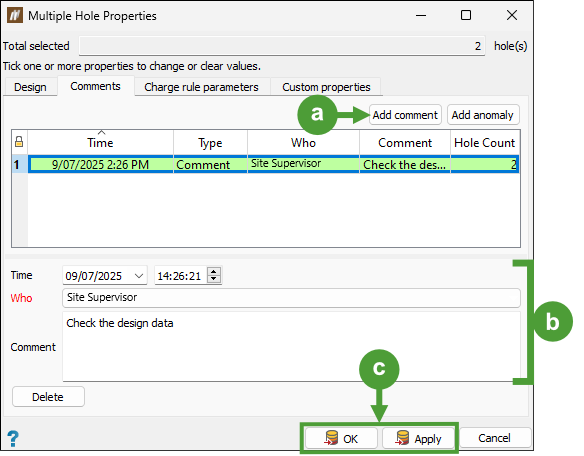
Use the Comments tab to leave comments or record anomalies in the records of the selected holes, as follows:
-
Select the required holes in the view window.
-
Click on the Comments tab in the Multiple Hole Properties panel.
-
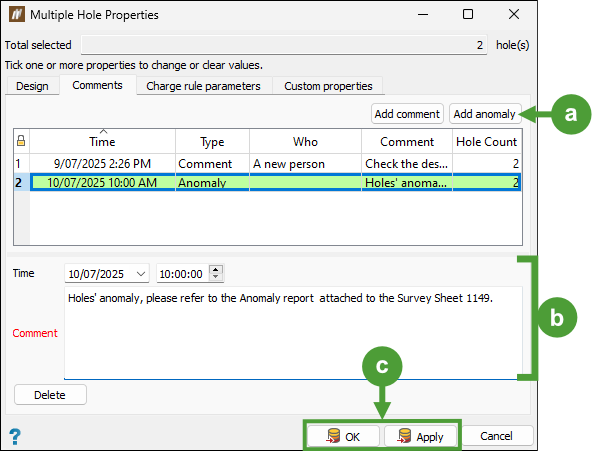
Add the required comment or anomaly as follows:
-
Click Add comment at the top of the table in the Comments tab.
-
Enter the required information (date and time, the person making the comment, and the comment content).
-
Click OK or Apply to add the entry to the holes' history.
-
Click Add anomaly at the top of the table in the Comments tab.
-
Enter the required information (date, time, and the anomaly content).
-
Click OK or Apply to add the entry to the holes' history.
| Adding a comment |
Tip: To edit a comment, select it in the table, update the information as needed, and click OK or Apply to save your changes. |
|
Adding an anomaly |
|
Note: The Hole Count column in the table contains information on the number of holes in your current selection that contain the given comment or anomaly.
Note: To delete a comment or anomaly entry you no longer need, select it in the table in the Comments tab and click Delete.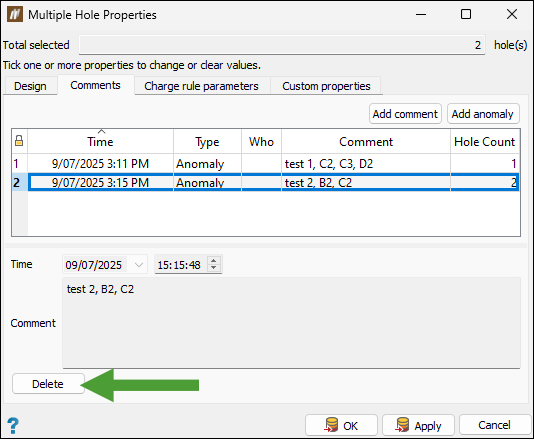
Tip: Select the blast and go to the Analysis ribbon > Report group >  Blast Summary Report > Anomalies tab to check the information for all anomalies recorded for the given blast.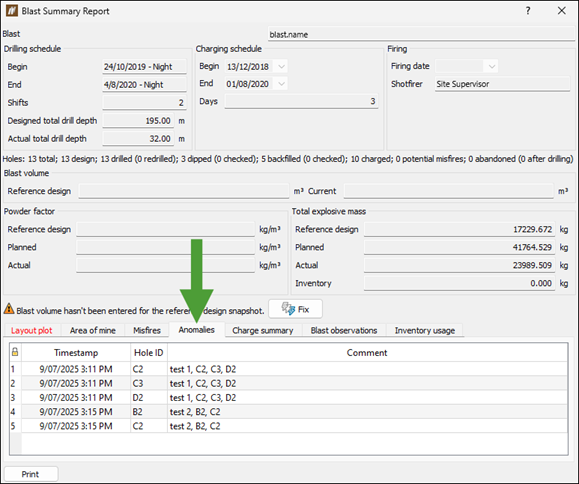
Charge rule parameters
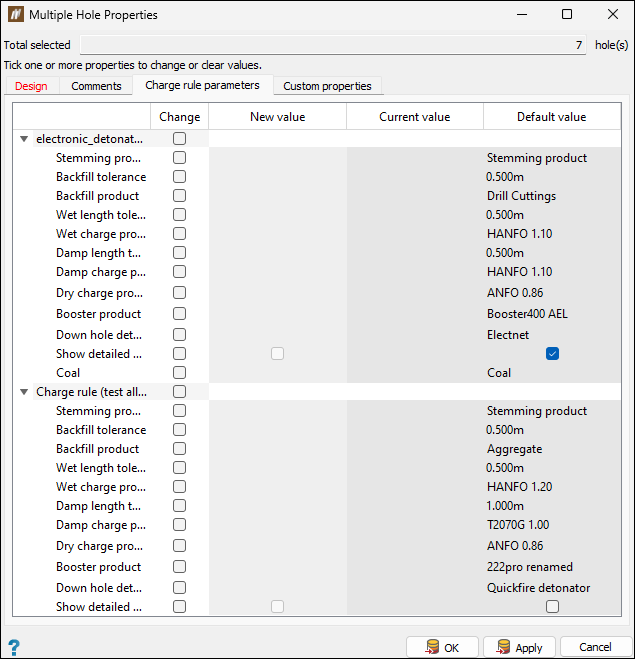
Use the Charge rule parameters tab to view and modify the charge rule properties for the selected holes. This allows you to make small modifications to how holes are charged, without having to clone or rewrite the charge rules.
To edit the charge rule parameters for the required holes, follow these steps:
-
Select the required holes in the view window.
-
Enter the Multiple Hole Properties panel and click on the Charge rule parameters tab.
-
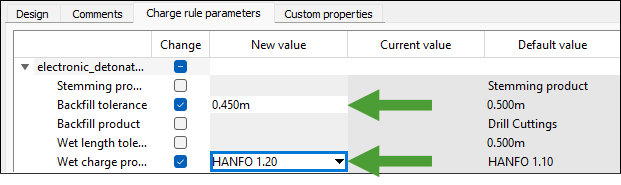
Select the checkbox in the Change column corresponding to the parameter that you want to edit.
-
Depending on the type of parameter that you selected, enter the new value or select the required option from the drop-down in the New value column.
-
Click OK or Apply to save the changed charge rule properties.
BlastLogic will display the values that you have applied in the Current value column.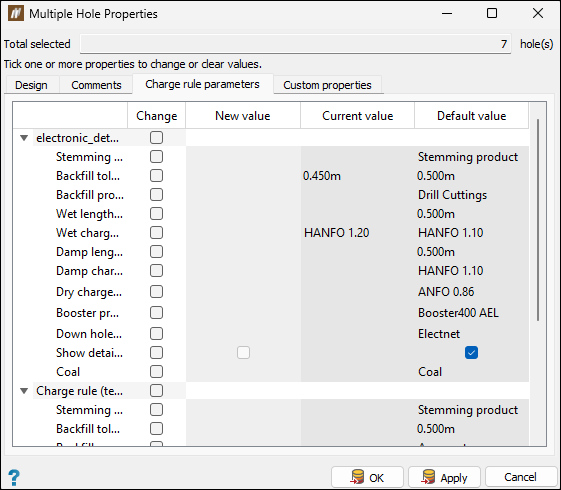
Optionally, to run the charge rule with the updated parameters, choose the desired holes and navigate to the Charging ribbon > Design group and select
 Update charge plans (see Update Charge Plans for details).
 Note: The values shown in the Default value column will be used for the charge rule if you do not specify any new values. To revert to the default value, select the checkbox in the Change column corresponding to the parameter to which you want to reassign the default value, and enter the value in the New value column. Confirm by clicking OK or Apply.
See also: Create Charge Rule
Custom properties
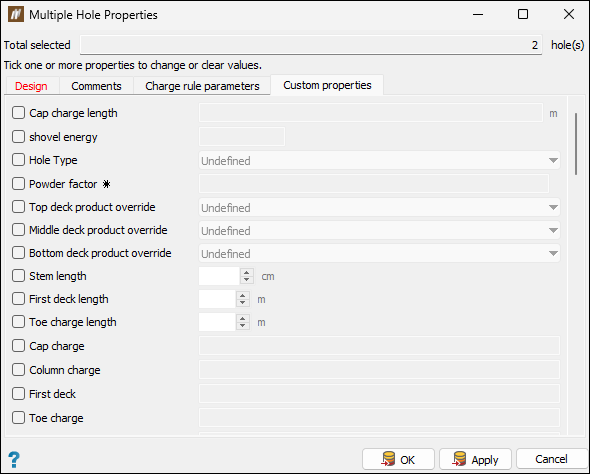
Use the Custom properties tab to view and modify custom hole properties for the selected holes.
To edit custom properties of multiple holes, follow these steps:
-
Select the required holes in the view window.
-
Enter the Multiple Hole Properties panel and click on the Custom properties tab.
-
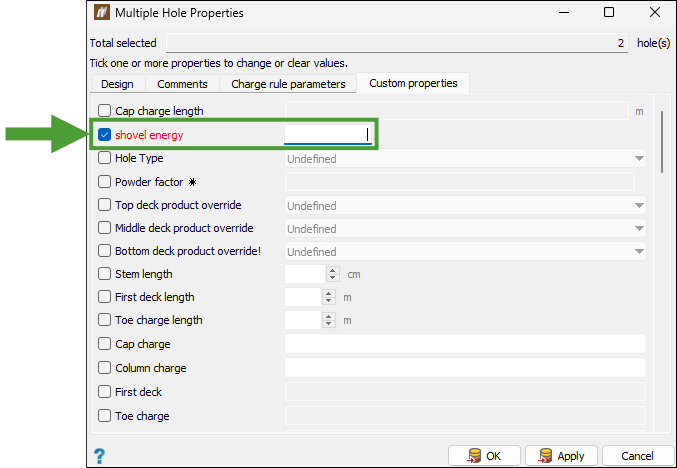
Select the checkbox corresponding to the required property to enable editing.
-
Depending on the property type, select the required option from the drop-down or enter the value manually.
-
Click OK or Apply to save your changes. BlastLogic will apply these custom property settings to all selected holes.
