

Borehole Compositing
VULCAN supports six kinds of down hole compositing techniques. These are:
- Straight compositing - simple XYZ calculation for the position of each sample with its lengths.
- Run length compositing - compositing samples to particular lengths.
- Bench composites - compositing samples restricted by upper and lower elevations.
- Geology - compositing by the longest possible geological features.
- Carry and makeup - compositing according to a specific set of rules such as minimum thickness, maximum roof cut, maximum floor cut, maximum allowable ore/waste ratios etc.
- Client specific compositing - Maptek works closely with its clients and appreciates that some deposits require specific techniques. We can develop a set of client specific composing rules for use in the Vulcan system.
In addition to the actual composition of samples, many other factors have a bearing on the compositing process. These include the handling of non logged, non sampled values, how to treat holes with errors, which holes to composite, composite flagging by ore type and of course sample selection.
Vulcan has easy to use tools which take care of these factors according to user preference, including the flagging of samples by triangulations, in which case the samples inside the triangulations are identified.
Once the sets of rules are complete, they are saved for re-use in later runs.
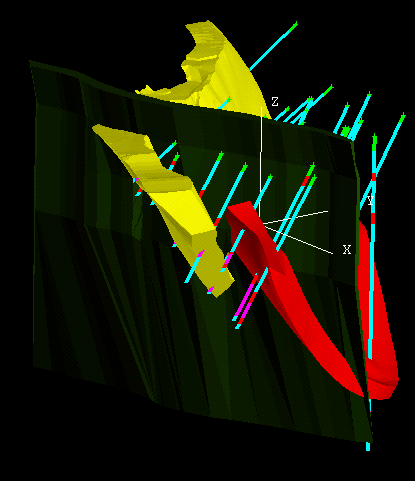
The Compositing Module allows each composite run to be saved as a group to a user specified database. This means that individual compositing runs may be saved as separate groups in a single file, and the individual run (or grouped groups) used in later processes (such as variography). Simply put, this means that composites from various sampling phases can be maintained in one composite database. Composites may also be written to ASCII file format for analysis in geostatistical packages not supported in Vulcan.
By default the compositing routines calculate the top x,y,z, mid x,y,z and bottom x,y,z positions for each composite. The composite for each drillhole can then be displayed graphically as either a single point or as drill segments. The standard statistical analyses as described below are also available for the composites, whether in ASCII or database format. By intersecting the values from a composite database, or an ASCII file, the average (uninterpolated) grade or weighted average for up to six variables at a time may be calculated.
