

Glossary
| A | B | C | D | E | F | G | H | I | J | K | L | M | N | O | P | Q | R | S | T | U | V | W | X | Y | Z |
- Abort
- To terminate a process prior to completion.
- Absolute Path
- A path that specifies the exact location of a file.
- Abutment
- Support pillar on which a roof in a mine rests.
- Anchor File
- This is a file associated with VulcanMDS that a user will have locally in their project folders, Vulcan is able to read these files which point to the associated file on the VuclanMDS server. They will have the standard Vulcan file extensions (
.bmf,.dgd.isis,.00t, etc.) but will only be about 1 kb in size. The files can be shared among users as long as the user has access to the server. - Actors
- A piece of Vulcan data that can appear in one or more frames. The three types of actors available are: triangulations, layers and grids.
- Alignment
- When the alignment is created, the points on it are given chainage values. Each point on the alignment is given a value which is a linear distance along the curve, from a given starting point.
- Alternate Data Area
- An alternate or alternative data area is an area other than the current working directory. Alternative data areas can be accessed from in Vulcan for layers (List Layers option under File > Layers).
- Animation
- To run a sequence of frames at a set speed. Frames can be made up of objects, layers, triangulations and grids.
- Anisotropy
- The condition of a property having different values in different directions, as in geologic strata that transmit sound waves with different velocities in the vertical and horizontal directions.
- Annotations
- Text that can be printed or plotted as opposed to labels that can only be printed/plotted if put into a layer.
- Anticline
- An anticline is a fold in rocks that brings rocks up from depth, forming an arch-like structure. The rocks in the centre of an anticline are the older rocks.
- AOFI
- Short for Area of Influence.
- Append
- Adding to the end of an existing line, database or layer.
- Aquiclude
- A saturated but poorly permeable bed, formation or group of formations that does not yield water freely to a well or a spring. However, an aquiclude may transmit appreciable water to or from adjacent aquifer.
- Aquifem-n Layer
- Aquifem-n allows multiple layer groundwater models to be defined where each layer models an aquifer unit. The layers must be numbered in increasing order from the land surface downwards (i.e. the uppermost layer is one, the next layer is two etc.) and are conceptually linked by the aquitard between each aquifer. The concept of an Aquifem-n layer should not be confused with that of a design database layer.
- Aquifer
- A formation, group of formations or part of a formation that contains sufficient saturated permeable material to yield economic quantities of water to wells and springs.
- Aquitard
- Stratigraphic layer or layers that may be permeable enough to transmit water in insignificant quantities in the study of groundwater flow, but their permeability is not sufficient to allow the completion of production wells in them.
- Archive
- Usually to back up and store away. In some instances it refers to saving a layer to a text formatted file (ASCII) so that other computers can read it.
- Area of Influence
- Usually termed Cone of Depression. A depression in the groundwater table or potentiometric surface that has the shape of an inverted cone and develops around a well from which water is being withdrawn. It defines the area of influence of a well.
- Arithmetic Mean
- The sum of the values of <n> numbers divided by <n>. It is usually referred to as the "mean" or "average".
- Assay
- Verb: To subject a given material to chemical analysis.
Noun: An analysis of the constituents in a given material. - Assay Grade
- The percentage of valuable constituents in an ore, determined from the assay.
- Assay Value
- The quantity of a given material's specified constituent.
- Assign
- Apply.
- Attenuation
- The reduction in energy of any wave form as it passes through a medium.
- Average
- Equivalent to Arithmetic Mean.
- Awk
- A file processing utility for UNIX operating systems.
- Azimuth
- The direction of a horizontal line as measured on an imaginary horizontal circle. It is the horizontal direction expressed as the angular distance between the vertical plane passing through the observer and the poles of the earth and the vertical plane passing through the observer and the object under observation.
- B -
- Backfill
- Any material returned underground to fill mining excavations. Often this is crushed rock with cement added. Many mines have a backfill plant that makes this rock and cement mixture for emplacement in slurry form.
- Backsight
- (a) A sight or bearing on a previously established survey point (other than a closing or check point), taken in a backward direction.
(b) A reading taken on a level rod held in its unchanged position on a survey point of previously determined elevation when the levelling instrument has been moved to a new position. It is used to determine the height of instrument prior to making a foresight. - Base of Weathering
- In seismic work, the boundary between a low velocity surface layer and an underlying, comparatively high velocity layer. It often corresponds to the water table. It is important in deriving time corrections for seismic records.
- Batch
- Method for running one or more commands. Generally consists of creating a file that contains multiple commands which themselves can be other batch or script files. A batch file may run a set of Grid Calc macros or run a series of grade estimations on a block model. It may also be a method of making multiple plots, for example create 10 sections 50 units apart. Usually for printing/plotting purposes.
- Batters
- The batters are the sloping sides of the cross section, which come about when the road section cuts into the terrain or when the road is above the terrain and fill is needed. In the Iroad module the batters can be specified as either normal or catchline type.
- BCF
- Short for Block Centred Flow package.
- Bearing
- The direction of a line with reference to the points of the compass, commonly expressed as an angle of less than 90 degrees measured East or West from the meridian and referred to either the North or South point. In Europe, bearing is usually referred to between 0 and 360 degrees clockwise from North (0/360 = North, 90 = East, 180 = South, 270 = West).
- Bedding
- In stratigraphic terms, formed, arranged or deposited in layers or beds, or made up of or occurring in the form of beds, especially said of a layered sedimentary rock, deposit or formation. The term has also been applied to non-sedimentary material that exhibits depositional layering, such as the "bedded deposits" of volcanic tuff alternating with lava in the mantle of a stratovolcano.
- Beds
- In stratigraphic terms, a bed (or beds) is the smallest formal lithostratigraphic unit of sedimentary rocks. The designation of a bed or a unit of beds as a formally named lithostratigraphic unit generally should be limited to certain distinctive beds whose recognition is particularly useful. Coal beds, oil sands and other beds of economic importance commonly are named, but such units and their names usually are not part of formal stratigraphic nomenclature.
- Bench
- A flat working area in an open pit or underground mine formed by drilling and blasting to make a step in the mine profile.
- Bench Compositing
- A composite technique similar to the Run Length technique, except that the composite intervals are determined by chopping the drill hole by bench rather than by downhole lengths. For example, imagine a set of drilling passing through a set of planned benches in a proposed pit. The bench composites are determined by averaging the grades that fall in a bench. Note that the same comments concerning composite length apply as they do to the Run Length technique.
- Berm
- Margin or shoulder of a road, higher than the road itself. Sometimes called a safety berm.
- Blast Envelope
- The extra selvage applied to a blast area to provide maximum rock breakage.
- Blast Holes
- Holes drilled in an open cut or underground mine in order to be charged and then blasted.
- Block Centred Flow
- A Modflow package. The BCF package is used to describe the Modflow model dimensions (row height, column width), layer types (confined, unconfined or variable) and the hydrologic properties of the layer(s), for example transmissivity, storage, anisotropy etc. BCF1 is the original package. BCF2 introduced the facility to allow rewetting of cells which had gone dry. BCF3 extended the way in which intercell transmissivity is calculated.
- Block Model
- A series of cuboids which collectively define a larger cuboid. Each cuboid, referred to as a "block" or "cell" defines an exact piece of the three dimensional space. A series of variables or attributes are assigned to each block and in this way the entire volume covered by the block model is defined.
- Block Tonnage
- Mass of a block in a block model, mining block or Whittle volume multiplied by density.
- Boolean Functions
- A method of splitting intersecting triangulations removing overlaps.
- Bord and Pillar
- Equivalent to Room and Pillar mining.
- Boreholes
- Long cylinders drilled into the rock from which samples are taken at intervals.
- Bowditch
- A survey adjustment method that takes a graphical object representing a traverse of some kind and performs a Bowditch adjustment, generating an additional graphical object representing the adjusted traverse, with a detailed report.
-
Eastings correction = Easting misclose (traverse leg length/total traverse distance) -
Northings correction = Northing misclose (traverse leg length/total traverse distance) - More information can be found in Appendix B of the Survey documentation.
- Box Cut
- A box shape excavation in an open cut coal mine, usually the first cut.
- Breaklines
- Lines that assist with formation of triangulations, triangles cannot form across breaklines.
- Bug
- Error, fault.
- Bulking Factor
- A numerical value applied to material to represent the amount of swelling during the mining process.
- Bull's Eyes
- Contours that fall entirely in a triangle or grid cell. Spline surfaces may produce undesirable hills and depressions. These are recognised by nested contours falling entirely in the same triangle. This is caused by one node of a triangle having a very much larger or smaller value than the other two nodes (or one or two nodes of a grid cell).
- Burden
- The distance between a blasthole and the nearest free face or the distance between two successive rows of holes used in a drilling pattern for a blast. See Spacing.
- C -
- CF
- Short for Cut and Fill.
- Carry & Makeup
- This compositing technique calculates metal equivalents for any one sampling interval. Widths of intersection are also calculated for sample intervals. The compositing then proceeds depending on the user selections for First Carry, Make Up and Final Carry.
- Cascading
- A consecutive sequence of processes connected in series.
- Centroid
- The gravitational centre point of a two dimensional or three dimensional object.
- Chainage
- In road design, when the alignment is created, the points on it are given chainage values. Each point on the alignment is given a value which is a linear distance along the curve, from a given starting point.
- Channel Sampling
- Original definition: Samples taken along traverses at specified intervals usually in underground mines but can be taken along walls or faces in open cut mines.
Dictionary definition: A composite rock sample, generally taken across the face of a formation or vein to give an average value. - Char Histogram Plot
- This plot type produces a histogram showing the number of character values that match a specified list of character patterns.
- Charge
- The explosive load in a blasthole (noun). The act of loading explosives into a drillhole, quite often known as "charging up" (verb).
- Chord
- A straight line joining any two points on an arc, curve or circumference.
- Circumferential Road
- A road that goes around the circumference of something, for example a pit, a dump, a site, etc.
- Clear
- Remove.
- Clip
- Remove, for example clipping strings to the edge of a polygon would mean that the strings outside the polygon would be removed.
- Closed Triangulation
- A triangulation containing no boundary edges.
- Coal
- A readily combustible rock containing more than 50% by weight and more than 70% by volume of carbonaceous material including inherent moisture, formed from compaction and induration of variously altered plant remains similar to those in peat. Differences in the kinds of plan materials (type), in degree of metamorphism (rank), and in the range of impurity (grade) are characteristic of coal and are used in classification.
- Coalesce
- Combine two or more objects into one object.
- Coal Seam
- A stratum or bed of coal.
- Coaly
- Covered with coal, or containing or resembling coal; for example coal rashings, small pieces of soft, dark shale containing much carbonaceous material.
- Coefficient of Variance (CV)
- The ratio of the standard deviation divided by the mean, multiplied by 100, so that it is expressed as a percent. Sometimes called the relative standard deviation.
- Colour Legend
- Colour legends control the colour of the data to be displayed. They are created in a specific folder (colour scheme) and stored in the <proj>.scd file. Various legends may exist, for example AU to colour by gold, CU to colour by copper.
- Colour Scheme
- Folders in the <proj>.scd file that contain colour legends. The folders delivered with the system are: Block, Channel, Contour, Drill, Geotech, Map, Mistie, Samples, Seismic, Strata and Texture. For example, colour legends AU and CU in the Drill folder to colour drillholes by gold or copper, a colour legend AU in the Block folder to colour block model variables by gold.
- Composites
- Assignment of values from drillhole data to predefined intervals, which are made up of a top, bottom and mid, Easting, Northing and Elevation co-ordinates.
- Compute
- To calculate (an answer, result), often with the aid of a computer.
- Constituents
- Forming part of a whole, component.
- Construction Points
- Graphical representation of any defined 3D (X, Y, Z) point in space. As such they may be "picked" when in "snap" mode in Vulcan, thus providing an exact 3D coordinate position without typing the co-ordinates or creating new data. Construction points have the highest priority in the snap sequence (however, they are not data points).
- Contour
- (a) An imaginary line, or a line on a map or chart, that connects points of equal value, for example elevation of the land surface above or below some reference value or datum plane, generally sea level. Contours are commonly used to depict topographic or structural surfaces; they can also readily show the laterally variable properties of sediments or any other phenomenon that can be quantified.
(b) The outline or configuration of a surface feature seen two dimensionally, for example the contour of a mountain pass or a coastline. - Contour Diagram
- An equal-area projection of structural data in which the poles have been contoured according to their density per unit area on the projection.
- Contour Interval
- The difference in value between two adjacent contours; specifically the vertical distance between the elevations represented by two successive contour lines on a topographic map. It is generally a regular unit chosen according to the amount of vertical distance involved and the scale of the map, but it need not be constant over the entire map (a variable contour interval may be used for optimum portrayal of relief features).
- Contour Map
- A map that portrays surface configuration by means of contour lines; especially a topographic map that shows surface relief by means of contour lines drawn at regular intervals above mean sea level, or a structure contour map that shows the configuration of a specified rock surface underground and the inferred configuration of that surface where it has been removed by erosion.
- Control Points
- Used as absolute or relative reference points for design work (points themselves are not included). They are stored in a control points table.
- Control Survey
- A survey that provides horizontal and/or vertical position data for the support or control of subordinate surveys or for mapping; for example a survey that provides the geographic positions and/or plane co-ordinates of triangulation and traverse stations and the elevations of bench marks. Control surveys are classified according to their precision and accuracy: the highest prescribed order is designated first order, the next lower is second order and so on.
- Conversion
- Modification of existing software to enable it to operate with similar functional capability in a different environment; for example, converting a program from Fortran to Ada, converting a program than runs on one computer to run on another.
- Coord
- Short for co-ordinates.
- Coordinate
- Any one of a set of numbers designating linear and/or angular quantities that specify the position of a point on a line, in space or on a given plane or other surface in relation to a given reference system; for example latitude and longitude are co-ordinates of a point on the earth's surface. The term is usually used in the plural, especially to designate the particular kind of reference system (such as "spherical co-ordinates", "plane co-ordinates" and "polar co-ordinates").
- Coordinate System
- A reference system for defining points in space or on a particular surface by means of distances and/or angles with relation to designated axes, planes or surfaces, i.e. polar co-ordinates.
- Coordinate Window Identifier
- This may be used in the project specification file name (it is optional). It is used to create different
.dg1files for the same project. This may be useful if you require different coordinate ranges for different geographic locations or different display specifications. - Co-planar
- A set of points is coplanar if a single plane can be created to touch each point in the set. Sets with 1, 2 or 3 points are always coplanar because it is always possible to construct such a plane.
- Crest
- The top of a batter or mining block.
- Crop Layer
- A crop layer is a layer in a design database - specified in the 'crop design db' field - containing limiting polygons for a horizon. The polygons are not limited to crop lines, but should define the physical extent of each horizon. In the case of splits, the lines will also define the extent of each split. These limit polygons can be determined in a variety of ways. Sometimes it is necessary to run a model without limiting seams and then use contour lines (for example thickness of overburden) to determine the extent.
- Cross Cuts
- A development opening in an underground mine that is driven across or to the orebody. This is in contrast to a drive that is driven along the orebody. These two openings are therefore at right angles to each other.
- Crossfall
- The vertical fall of a road from centre to the side.
- Cross Section
- A diagram, drawing or view along any axis (not just the long axis, this is a special case called a long section) and at any angle (usually vertical). The section can be horizontal, but usually in Vulcan we refer to this as a plan section or a plan map. Cross sections are planar sections through your data at any orientation you desire. Think of a chunk of ground and imagine inserting a piece of paper down into it. You can hold the paper North-South, East-West or any other way and it does not have to be straight up and down, it can be at a large or slight angle. Then if you took away all of the earth except the part on one side of the paper you would see a cross section. Mot common are vertical cross-sections at North-South or East-West orientations.
- CSV Tables
- Comma Separated Values tables.
- Cubic Spline
- A model that represents a smooth curve passing through specified points, which are interpolated functions in their primary and secondary derivatives.
- Cumulative Plot
- This plot type produces a graph showing the percent below values for each selected variable. The graph increases from 0 to 1.
- Curvature
- Something curved or a curved part of a thing.
- Cut and Fill
- In engineering terms, the excavating of material in one place and the depositing of it as compacted fill in an adjacent place, as in the building of a road, canal, or embankment or in stope mining.
- Cut-off Grade
- The assay grade below which the orebody cannot be profitably mined.
- D -
- Dataset
- A composite database, block model, general database, grid or Vulcan screen object.
- Datasheet
- The template incorporating records and fields into which ASCII data can be loaded to form a database. Also known as the structure of a Vulcan Isis database.
- In some version of Vulcan, datasheets are named Designs.
- Datum
- In mining terms, a reference level from which differences of height in a mine are measured. Most underground mines choose a datum well below their expected working depth so that all heights are positive above the datum. In general terms, datum is a reference level. Elevations for example, are measured around the world as height above sea-level. In this case sea-level is the datum.
- Datum Horizon
- A geologic horizon used as a reference plane for the position of rock strata or for the comparative measurement of the thickness of strata; the key horizon or bed on which elevations are taken or to which all elevations are finally referred in making a structure-contour map.
- Daylight Window
- A block sticking out into free space, i.e. it rests on an inclined weakness as the result of a slide on a rock face.
- Decline
- An underground development opening that runs at an angle, usually 1 in 7 for diesel equipment.
- Delineation
- A step in map compilation in which map-worthy features are distinguished and outlined on various possible source materials or are visually selected (as when operating a stereoscopic plotting instrument).
- Decluster
- Assign different weights, based on the location of data points, to a set of data points.
- Departure
- The projection of a line onto an East-West axis of reference. The departure of a line is the difference of the meridian distances or longitudes of the ends of the line. It is East or positive (sometimes termed the Easting) for a line whose azimuth or bearing is in the North-East or South-East quadrant; it is West or negative (sometimes termed the Westing) for a line whose azimuth or bearing is in the South West or North West quadrant.
- Depletion
- When mining reduces or exhausts the ore reserve of a mine this process is known as depletion.
- Deposit
- (a) Earth material of any type, either consolidated or unconsolidated, that has accumulated by some natural process or agent. The term originally applied to material left by water, but it has been broadened to include matter accumulated by wind, ice, volcanoes and other agents.
- (b) An informal term for an accumulation of ore or other valuable earth material of any origin.
- Deselect
- Remove, un-select.
- Design database
- Contains all design information relating to a project, such as coordinate points, lines, polygons, features and text annotations. May contain data relating to single map sheets covering the same defined area or may be dedicated to a particular type of data, for example contours, roads or to a particular discipline. File name consists of a user-defined Project Code and a Spatial Database Identifier (
sdi). The file extension is.dgd. Associated with a design database is the corresponding database index file (extension .dgx). - Design Database Work File
- Data is not stored in a design database until it is saved. Prior to a saving operation, any changes or new work are performed on the work copy which is a copy of the last saved version of the database. This copy is referred to as the work file. Work files allow the recovery of data in the unlikely event of a system failure.
- Design Entry Modes
- Modes for digitising, for example
 Indicate,
  Snap to Objects,
  Snap to Points,
  Snap to Grid,
  Keyboard,
  Bearing Input,
  Construct Line At Given Angle. The mouse can use any of these modes, graphic terminals allow only Keyboard mode and digitisers only Indicate mode. See also Toolbars.
 - Desurveying
- Applying tangential calculations of dip and strike to a drillhole database.
- Device
- A mechanism or piece of equipment designed to serve a purpose or perform a function.
- DG1
- This is a project specification file containing the geographic co-ordinates of the primary or start-up window in which you want to work. The format of the file name is
<name>.dg1. - Digital Terrain Models
- Also referred to as DTMs. They are the same as triangulation models. Sometimes known as Digital Elevation Models (DEMs) when modelling topography.
- Digitise
- To transcribe data into a digital form for processing by a computer (digital form represents the data as a series of numerical values).
- Digitised Map
- (a) A map expressed or stored in digital form.
- (b) A map prepared from cartographic information that has been converted from analog to digital form for use in automatic plotters.
- Dike
- A tabular igneous intrusion that cuts across the bedding or foliation of the country rock.
- Dilution
- To add more of one commodity to make the resulting mixture less concentrated, i.e. adding waste to an ore parcel = less ore per tonne.
- Dimensions
- A type of label which puts the dimensions (measurements) onto objects, such as line drawings. Useful for engineering drawings.
- Dip
- The amount of tilt a structural surface expresses when compared to the horizontal plane.
- Dip Angle
- The vertical angle, measured at an observation point in surveying or at an exposure station in photogrammetry, between the plane of the true horizon and a line of sight to the apparent horizon. See also Dip.
- Dip Direction
- The geographic direction at which a structural surface is tilting. This is always 90 degrees off strike direction.
- Direction
- (a) The position of one point relative to another without reference to the distance between them. It may be three dimensional or two dimensional.
(b) The angle between a line or plane and an arbitrarily chosen reference line or plane; specifically the angle between a great circle passing through both the position of the observer and a given point on the earth's surface and a true North-South line passing through the observer. When the reference line is North and the angle is designated East or West, the direction is called the Bearing ; when the reference line is South and the angle is reckoned clockwise, the direction is called the Azimuth. - Disable
- Switch off.
- Discretisation
- Used in block estimation where blocks are divided into equal portions each having a grid point and individual estimates are applied to each grid point. Gives a smoothing effect to a block estimation.
- DM
- Short for Datamine.
- Downhole Spatial Database
- Database that stores X/Y/Z coordinate and other information, used to display holes on the computer screen and for plotting. These files have the extension
. dsr. See Desurveying. - Downhole Survey
- A measurement of dip and azimuth of a borehole at one or more intervals down its entire length.
- Drag
- Moving to a new position.
- Dragline
- Item of earth moving equipment that consists of a rotating upper works equipped with a long boom from which a bucket is suspended by a wire rope powered by a winch. The bucket is dropped into an excavation and the bucket is dragged by another rope towards the machine filling in this process. The bucket is then elevated and dumped by interaction of the two rope winches.
- Drape
- Putting something, for example an image or data, over a grid mesh, triangulation or block model.
- Drill
- Any powered device that will produce a circular hole in rock. The power may be hand, compressed air, electrical or hydraulic.
- Drillhole
- A hole produced by any type of drill, sometimes known a borehole or, in the oil industry, as a well.
- Drill Pattern
- The layout of drillholes varies from simple single row where the hole location is determined by only its spacing and burden to complex designs in multi-row blasts where a pattern based on an equilateral triangle is recommended.
- Drivage
- Roadways that are created freehand.
- Drive
- A development opening in an underground mine that runs along or is parallel to the general trend of an orebody, compare Crosscuts.
- Dropout
- Elimination. For example, minor contour dropout to eliminate minor contours that are close together, i.e. where there is a steep gradient.
- Duplicate
- Copy.
- DXF
- Data exchange file.
- Dyke
- Equivalent to Dike.
- E -
- Easting
- A departure (difference in longitude) measured to the East from the last preceding point of reckoning; for example a linear distance eastward from the North-South (vertical) grid line that passes through the origin of a grid system.
- Edge
- One side of a facet, connects two vertices.
- Edit
- To modify. For example, to insert or remove triangles from a triangulation or to add points to a string (object).
- Effective Flat Haul Routes
- Travelled distances converted to equivalent flat route distances. Generally considers the speed on real routes compared to a set speed.
- Element Flux
- The measure of Darcy flux or Darcy velocity for a specific element of a flow net.
- End Plates
- The two dimensional triangulations used to cap off an open ended three dimensional triangulation.
- Environment
- The Environment code is used when referring to the structure of Isis Library Databases. These databases require additional information to define the way in which the data are stored internally. This information is found in the dd.ilb file, which must be present in order for the database to be accessed. Use Isis, the database editor, to manipulate the contents of the dd.ilb files. By convention, the project and environment codes should not be the same.
- Environment Variables
- A variable that points to a certain directory. For example, the environment variable $ SURVEY_DATA points to a directory where the survey data is kept. Refer to Setting Environment Variables in the System Administration documentation for details.
- Vulcan
- The proprietary name for the Vulcan 3D Viewer and Editor. Vulcan is used to display and manipulate data in a three-dimensional format. Data types include design data, grid models, triangulation models, block models and drillhole databases.
- Equal Area Projection
- A map projection on which a constant ratio of areas is preserved, so that any given part of the map has the same relation to the area on the sphere it represents as the whole map has to the entire area represented. Examples include: Bonne projection, Albers projection and Mollweide projection.
- Equidistant Projection
- A map projection in which distances are represented true to scale and without length distortion in all directions from one or two given points.
- Exag
- Short for Exaggeration.
- Exponential
- A mathematical model used in semi variogram modelling and other modelling functions where a straight line that is closely approached by a curve so that the distance between them decreases to zero as the distance from the origin increases.
- External Box
- Defines the sheet (paper) area in a drafting sheet. Drafting sheets, which are also known as plot templates or border styles, are stored in your drafting database (
drafting.dgd.isis). - Extrapolate
- To estimate beyond the known values, by the extension of a curve. This involves inserting extra points.
- Extrusive
- Said of igneous rock that has been erupted onto the surface of the earth. Extrusive rocks include lava flows and pyroclastic material such as volcanic ash.
- F -
- Face
- The working face is the surface exposed by current mining. It may be the face of a development end or of a Stope.
- Facet
- A triangle in a triangulation.
- Fault
- A fracture surface or tabular zone in a rock body, along which one side has been offset relative to the other.
- Fault Line
- The trace of a fault surface or zone on the earth's surface, or on any artificial or imaginary surface, such as mine levels or elevation contours. This term is used most commonly for the map trace of a fault.
- Fault Plane
- Where a fault has formed from a single fracture, the fault plane is a surface along which fracture and displacement have taken place. The term transforms to a zone where there are many surfaces acting together to form an area of fracture.
- Fault Surface
- In a fault, the surface along which displacement has occurred.
- Feature
- Objects can be created with a feature. A feature is a set of object attributes that allow you to design logically similar objects without having to set each attribute every time you need it. An example of a feature would be colour, fill pattern, line type. A feature may also ask for coordinate point names, object names, forcing closure etc. Thus a feature might be defined for fault lines. This could be given a colour, name, line type, thickness and be forced to remain open on completion.
- Filter
- Reduce, taking out. For example, filtering excess points means taking out points not needed.
- Finite Element Mesh
- Genopt uses polygonal regions to define the geometry for generating a FEM model. This mesh consists of two dimensional linear triangular elements, making it identical in form to a Vulcan triangulation. For this reason the term "FEM triangulation" is used in the Envisage groundwater modelling documentation to refer to the mesh used by Aquifem-n as a basis for modelling. Similarly, the terms node and element may be used (where appropriate) to refer to vertices and triangles respectively.
- Fixed Survey Station
- One that is permanent and extremely accurate.
- Flag
- A variable that is set to a prescribed state, often "true" or "false", based on the results of a process or the occurrence of a specified condition.
- Flat Spots
- A flat area between wide spaced contour lines.
- Flat Triangles
- Triangle facet that is created from the same contour line, therefore it is horizontal. This is not generally wanted, a given facet should be attached to two different contour lines, each having a different elevation.
- Flexed Section
- A vertical section that does not follow a straight line, i.e. it has "hinge points" at which the section changes orientation, for example from south-west to east-west.
- FLEXlm
- Software developed by Globetrotter Software and used by the Licence Administrator.
- Floating Licences
- A licence that allows you to run Vulcan from any machine.
- Floating Point
- Any real number containing decimal points.
- Fold
- In structural geological terms, a general term for a planar arrangement of textural or structural features in any type of rock; especially the planar structure that results from flattening of the constituent grains of a metamorphic rock.
- Foliation
- The term foliation implies all planar structures marked by parallelism of fabric elements in a rock mass, that is all surfaces, primary and secondary, with the exception of joints. Foliation implies potential but not actual parting.
- Foresight
- (a) A sight on a new survey point, taken in a forward direction and made in order to determine its bearing and elevation. Also, a sight on a previously established survey point, taken to close a circuit.
(b) A reading taken on a level rod to determine the elevation of the point on which the rod rests. - Free Survey Station
- Free survey stations do not have known co-ordinates as do fixed stations. Co-ordinates for free survey stations are calculated using the Least Squares network adjustment (Surveying menu).
- Friction Cone
- Friction between rock surfaces can be represented on a stereonet by small circles in the projection. If the result of all forces acting on the block is inclined with the normal at an angle smaller than the friction angle (Ø), then the block will remain where it is. This in turn allows you to calculate that the allowable resultant forces is a cone of vertex 2ظ (twice the friction angle). Using this cone, it is possible to project onto the stereonet, a small circle around the centre of the projection net with a radius of Ø.
- G -
- GCDF
- Global Conditional Distribution Function.
- General Statistics
- Sometimes called univariate statistics. These include the average, standard deviation, median, skewness, geometric mean, harmonic mean, mean of logs, variance of logs, kurtosis, Sichel T, median, quartiles and a percentage distribution listing.
- You can select as many variables as you want to analyse. Each variable is analysed separately. For example, if you have a composite database with an AU field and a AG field and also a block model with an AU field and an AG field, when you select these four variables you will get four statistics, one for each variable.
- Geodesy
- (a) The science concerned with the determination of the size and shape of the earth and the precise location of points on its surface.
(b) The determination of the gravitational field of the earth and the study of temporal variations, such as earth tides, polar motion and rotation of the earth. - Geodetic Co-ordinates
- Quantities defining the horizontal position of a point on an ellipsoid of reference with respect to a specific geodetic datum usually expressed as latitude and longitude. These may be referred to as geodetic positions or geographic co-ordinates. The elevation of a point is also a geodetic coordinate and may be referred to as height above sea level.
- Geodetic Surveying
- Surveying in which the figure and size of the earth are taken into account and corrections are made for earth curvature; the applied science of geodesy. It is used where the areas or distances involved are so great that results of desired accuracy and precision cannot be obtained by plane surveying.
- Geodimeter
- Trade name of an electronic-optical device that measures ground distances precisely by electronic timing and phase comparison of modulated light waves that travel from a master unit to a reflector and return to a light-sensitive tube where an electric current is set up. It is normally used at night and is effective with first-order accuracy up to distances of 5-40 km (3-25 miles).
- Geographic Co-ordinates
- Equivalent to Geodetic Co-ordinates.
- Geology
- The study of the planet Earth - the materials of which it is made, the processes that act on these materials, the products formed and the history of the planet and its life forms since its origin. Geology considers the physical forces that act on the earth, the chemistry of its constituent materials and the biology of its past inhabitants as revealed by fossils. Clues on the origin of the planet are sought in a study of the Moon and other extraterrestrial bodies. The knowledge thus obtained is placed in the service of man - to aid in discovery of minerals and fuels of value in the earth's crust, to identify geologically stable sites for major structures, and to provide foreknowledge of some of the dangers associated with the mobile forces of a dynamic earth.
- Geometric Mean
- A statistic calculated by multiplying n data values together and taking the nth root of the result.
- Geometric Variance
- Sum of the nth root of n values.
- Geometrical Anisotropy (Affine Anisotropy)
- If the variogram in one direction can be transformed to that in any other by changing the scale of the gamma axis (variability).
- Geotech
- The study of structural attributes in rock masses.
- Grade
- Equivalent to Gradient.
- Gradient
- The amount of inclination from the horizontal of a road or rail track. Road grade is usually expressed in percentage terms (say 10%) except in the case of underground declines where (say) 1:7 is used, i.e. 1m rise in 7m horizontal or 14%.
- Graphical Attributes
- Things like line type, colour and pattern that can be applied to objects or symbols.
- Grid
- (a) A network composed of two sets of uniformly spaced parallel lines, usually intersecting at right angles and forming squares, superimposed on a map, chart or aerial photograph, to permit identification of ground locations by means of a system of co-ordinates and to facilitate computation of direction and distance. The term is frequently used to designate a plane-rectangular coordinate system superimposed on a map projection and usually carries the name of the projection; for example "Lambert grid".
(b) A systematic array of points or lines; for example a rectangular pattern of pits or boreholes used in alluvial sampling. - Grid Ledge
- That part of a grid surface which extends outside a limiting polygon.
- Grid Smoothing
- A method of smoothing sharp irregularities in potential-field measurements that arise from very shallow disturbances. A grid is drawn on a contour map and the smoothed value at a grid intersection is the average of values a fixed small distance away.
- Grid Surface
- Grid surfaces are regular meshes of two dimensional surfaces. They only hold data at each grid node and as such cannot accurately represent detailed irregular data. Grid surfaces, however, are able to place mathematical estimates of the data values between data points. A variety of algorithms are available to provide these estimates. See also the Overview to the Model documentation.
- Groundwater
- All water below the earth's surface. Water that enters a mine through cracks etc. in the rocks.
- Groups
- Objects can be put into groups. This allows you to edit similar objects from the same or different layers simultaneously.
- H -
- Hade
- In structural geology, the complement of the dip; the angle that a structural surface makes with the vertical, measured perpendicular to the strike. Synonym: rise, underlay.
- Halt
- (1) Most commonly, a synonym for stop.
- (2) Less commonly, a synonym for pause.
- Hanger
- Equivalent to Hanging Wall.
- Hanging Side
- Equivalent to Hanging Wall.
- Hanging Wall
- The overlying side of an orebody, fault or mine working; especially the wall rock above an inclined vein or fault. Synonym: hanging side, hanger.
- Hard Coal
- (a) A synonym of anthracite.
(b) Outside the U.S., the term is sometimes used for any coal with a calorific value higher than 5700 - Harmonic Mean
- The reciprocal of the arithmetic mean. The harmonic mean is always less than or equal to the geometric mean.
- Haul Cost
- The cost of hauling material from one destination to another. Usually applied to get ore from a mine stockpile to a mill.
- Haul Road
- The road out of an open pit mine to the crusher or waste dump.
- Header
- (1) A block of comments placed at the beginning of a computer program or routine.
- (2) Identification or control information placed at the beginning of a file or message.
- Headered Database
- An optimised Vulcan Isis database that contains the underlying design information in the header of the database.
- Heading
- Any horizontal opening being advanced in an underground mine.
- Head (Groundwater)
- A measurement of the potential energy at every point of a flow system. The hydraulic head (h) is the sum of two components: the elevation of the point of measurement (elevation head, z) and the pressure head (w) and is usually measured in metres or feet, i.e. h = z + w.
- High Wall
- The exposed unmined overburden face of a coal strip mine.
- Histogram Plot
- This plot type generates a histogram graph of the data selection. Options exist for linear, log and normal Gaussian scales on both the X and Y axes. The Normal Gaussian scale is a scale defined by the distribution of the data.
- For a histogram you, or the system, define intervals. The program displays a bar for each interval. The height of the bar depends on how many samples are in its interval. You can let the program choose intervals or you can define your own intervals by controlling the width of the intervals, the number of intervals or directly defining each interval.
- You can select any number of variables. Graphs are produced for every variable.
- Horizon
- Any mappable unit of interest, being a particular definable lithological unit or surface (for example coal seam, ore lens), or an arbitrary unit defined by depth or level (for example a bench) and which is named or uniquely described in the original database. Data defining a horizon or unit is summarised in a mapfile derived from the databases.
- Horizon Table
- A list of horizon names in top down order, i.e. horizons near the surface are specified first, then those deeper in the ground. This order is critical in Vulcan. A model is built off a base horizon. The modelling process adds thicknesses both upwards and downwards to generate the other horizons. Horizons that are of 'equal' priority, in particular the merged portion of two splits, can be specified either prior to or subsequent to the splits. The order in this case is not important.
- Horizontal Angle
- An angle in the horizontal plane.
- Horizontal Axis
- The axis about which the telescope of a theodolite or transit rotates when moved vertically. It is the axis of rotation that is perpendicular to the vertical axis of the instrument.
- Hot Keys
- Keyboard keys that can be assigned to menus or options that are frequently used. This allows access to those menus/options from anywhere in Vulcan.
- Hydrograph
- A graphical representation of the hydraulic head (y axis) versus time (x axis) for any point in a flow system.
- Hyperbolic Model Right Tail
- Used in Grade Estimation/Stochastic kriging. It gives a distribution with no maximum. If the power is greater than 1 (one), the distribution contains more values closer to the highest cut-off. If the power is less than 1 (one), the distribution contains more high values. The option on the Stochastic Estimation panel always allows for the possibility of arbitrarily large simulated values.
- I -
- Icons
- See Toolbars.
- Igneous Rocks
- Said of a rock or mineral that solidified from molten or partly molten material, i.e. from a magma; also, applied to processes leading to, related to or resulting from the formation of such rocks. Igneous rocks constitute one of the three main classes into which rocks are divided, the others being metamorphic and sedimentary.
- Impose
- To force.
- Inclination
- In drilling, the angle of the axis of a well bore measured from the vertical at a stated depth. In slopes, (a) a deviation from the true vertical or horizontal. Also, the amount of such deviation; the rate of slope or grade. (b) An inclined surface; a slope. In structural geological terms, a general term for the slope of any geological body or surface, measured in the upward or downward direction and from the horizontal or the vertical. If is often used synonymously with dip.
- Inclinometer
- A special type of monitor used to record change in borehole deviation over time. Also used in slope stability monitoring. They differ from the standard monitor (for example prism, wire extensometer) because they have multiple positions per time sample.
- Indicator Kriging
- A grade estimation technique that splits the grades into a series of ranges of "cuts". Estimation is then performed for each of the cuts; the full grade picture is built up from an average of these cuts.
- Indicator Variogram
- A variogram using an indicator transform, used as a precursor to indicator kriging.
- Inflow
- (a) The act or process of flowing; for example the flow of water into a lake.
- (b) Water that flows in; for example ground water and rainfall flowing into the stream of a drainage basin. Also, the amount of water that has flowed in.
- Influx
- Equivalent to Inflow.
- Insitu Geological Reserves
- Identified mineral resource as it occurs on surface or underground, quantified on the basis of geological data and an assumed cut-off grade.
- Instrument Station
- A station at which a surveying instrument is set up for the purposes of making measurements; for example the point over which a levelling instrument is placed for the purpose of taking a backsight or foresight.
- Int
- Short for Integer.
- Interburden
- A layer of sedimentary rock, of any composition and thickness, that separates two mineable coal beds. The term is used mainly in the strip-mining industry of the western United States. It has occasionally been applied in other surface mining, especially for phosphate rock.
- Interface
- (1) A shared boundary across which information is passed.
- (2) A hardware or software component that connects two or more other components for the purpose of passing information from one to the other.
- (3) To connect two or more components for the purpose of passing information from one to the other.
- (4) To serve as a connecting or connected component as in (2).
- Internal Box
- Defines the plot boundary area in a drafting sheet. Drafting sheets, which are also known as plot templates or border styles, are stored in your drafting database (
drafting.dgd.isis). - Interpolate
- To estimate (a function or value) between the values already known.
- Intersection Selection
- A complex composite technique. It determines composite intervals based on assay values. It tries to produce the longest possible composite interval, while maintaining a composite value above a certain cut-off. Once again, intersection selection operates in the drilling segments produced by the pre-processing steps.
- Interval
- (a) The period of time between two events, instants etc.
- (b) The distance between two points, objects etc. (c) A pause or interlude, as between periods of intense activity.
- Intrusive
- Said of rocks that are forced into pre-existing rocks. Dikes and sills are intrusive igneous rocks, injected in the molten state into previously solidified rocks.
- Invariance
- A mathematical quantity having an unchanging value or constant.
- Inverse Distance
- A grade estimation technique where the mean grade of a block is estimated by a weighted linear combination of nearby samples. The weight factor gives greater weight to closer samples.
- Inversion
- A reversal of order. No inversion is everything inside an object, full inversion is everything outside the object and partial inversion is everything above and around the object. In the context of compositing and block construction, no inversion is below for surface, and inside for solid.
- IP
- IPs or intersection points form the basis for creating the road alignment. They are a set of control points, which define the path that the alignment will take. These IPs may either be horizontal, to generate the horizontal alignment, or vertical, to generate the vertical grade. In the Iroad module the horizontal IPs have associated with them the radius of curvature of the alignment near that point, while the vertical IPs have the length of the parabolic arc near that point.
- Irregular Block Models
- Block models that have not been reblocked (i.e. they are subblocked). These can only be used by the Whittle 4D program. Cells in an irregular block model may be of different sizes.
- Isopach
- A line drawn on a map through points of equal true thickness of a designated stratigraphic unit or group of stratigraphic units.
- Isopach Map
- A map that shows the thickness of a bed, formation, sill or other tabular body throughout a geographic area by means of isopachs at regular intervals.
- Isotropic
- Equal distribution of a variable in all directions.
- J -
- Joint
- Fracture in rock, generally more or less vertical or transverse to bedding, along which no appreciable movement has occurred.
- Joint Plot
- This plot type produces statistics of correlation coefficients between any number of variable pairs. The variables must have the same number of elements. Joint statistics include correlation, rank correlation and linear least squares best fit and intercept and slope.
- Rank correlation replaces each data element with its rank in the distribution. If the elements are exactly in the same order in two distributions then the rank correlation will be 1. If the rank correlation is near 1 it means that the two distributions are similarly ordered. High values of the first variable generally correspond with high values of the second variable. The correlation coefficient may not be as high because one distribution is skewed to higher values.
- Jot
- A text editor for the SGI UNIX operating system (IRIX).
- K -
- Key Cut
- The excavation of overburden closest to the high wall of strip coal mine. The dragline usually starts at this point to ensure that the high wall is formed at the correct angle.
- Key Frame
- A list of frames and actors for the frames. Each frame displays one after another, to give the appearance of an animation.
- Knolls
- In geomorphological terms, (a) a small, low, rounded hill; a hillock or mound. (b) The rounded top of a hill or mountain.
- Kriging
- Linear estimation method. Best linear unbiased estimator. Takes into account the number of samples and quality, geometry of samples, distance between samples, spatial continuity and is unbiased.
- Kurtosis
- A measure of the relative peakedness or flatness of the curve defined by the distribution of cases. A normal distribution will have a kurtosis of zero. If the kurtosis is positive, then the distribution is more peaked (narrow) than would be true for a normal distribution, while a negative value means that it is flatter. Kurtosis is sometimes called the "fourth moment" and assumes interval-level data.
- L -
- Labels
- Text that can be printed and plotted only if put into a layer whereas Annotations can always be printed/plotted.
- Latitude
- The angle that the normal to a given point on the surface of a sphere or ellipsoid makes with the plane of the equator; specifically angular distance of a point on the earth's surface North or South of the equator, measured along a meridian through 90 degrees.
- Layers
- Logical data groups in a design database. A layer usually brings together a group of similar objects and data. For example, in a file representing a map sheet, all 200 metre contours may be in one layer and 100 metre contours in another. Layers are the major classification grouping in a file. Layer names can contain up to 40 alphanumeric characters (spaces cannot be used). The layer name is the primary access key into the digitised data file and a list of current layers is maintained in the
.dgxfor access purposes. Layer names should always be chosen to help recognise the contents as this is the selection criterion for both editing and designing. Layer names in the DIG$xxxxxxx format are reserved. - Least Squares
- A mathematical model for determining the most probable value of a single quantity from a number of measurements of that quantity; the probable error of the mean value of a number of observations; the best curve which may be drawn for a series of observed values of the ordinate over a range of values of the abscissa.
Also, a survey adjustment method that gathers observation data, performs adjustment and displays the observations graphically with a report. This method states that the sum of the weighted errors squared will be a minimum. The method is used to gather all required observational data to adjust a survey network using the variation of co-ordinates least squares approach. See Appendix B of the Survey documentation. - Lineation
- Original definition: A vector line on a rock surface.
- Line Plot
- Similar to a scatter plot but points are connected by lines. Each data pair is plotted in sequence, which means that the data needs to be logically organised in the data file, for example time series data.
- Line Split
- Splitting lines into one or more strings or inserting points in a string.
- Line Styles
- Line styles refer to a type of line consisting of patterns. Patterns can be "painted" on lines rather than just having a series of joined points. An example of where a line style could be applied would be a fence boundary. Line styles are created through the Line Style menu under File.
- Line types
- Line types refer to hardware line types such as a single full line, dotted, dashed etc. Hardware line types are delivered with Vulcan. Other types can be created through the File > Line Styles submenu.
- Lithology
- The description of rocks, especially in hand specimen and in outcrop, on the basis of such characteristics as colour, mineralogic composition and grain size. As originally used, "lithology" was essentially synonymous with petrography as currently defined.
- LocalHost
- This is the VulcanMDS server located on the machine that is currently running the VulcanMDS Manager.
- Local Tablet
- Local pointing device on a digitiser.
- Locked
- Usually occurs when trying to access a design database which is in use by someone else. For example, a file
<env><proj>.wrk_lockis created when a design database is being used. - Logger
- A person who observes and identifies rock samples and writes down their physical attributes.
- Longitude
- (a) An angular distance between the plane of a given meridian through any point on a sphere or spheroid and the plane of an arbitrary meridian selected as a line of reference, measured in the plane of a great circle of reference or in a plane parallel to that of the equator; specifically the length of the arc or portion of the earth's equator or of a parallel of latitude intersected between the meridian of a given place and the prime meridian (or sometimes a national meridian), expressed either in time or in degrees East or West of the prime or national meridian (which has longitude zero degrees) to a maximum value of 180 degrees. A degree of longitude on the earth's surface varies in length approximately as the cosine of the latitude, being 69.95 statute miles at the equator, 53.43 miles at lat. 40o, and zero at the poles; it represents four minutes of time, so that 15 degrees of longitude is equivalent to a difference of one hour of local time. Longitude may also be measured as the angle at the poles lying between the two planes that intersect along the earth's axis to produce the two meridians.
- (b) A linear coordinate distance measured East or West from a specified North-South line of reference, for example Easting and Westing.
- Long Section
- In the Iroad module the long section is the view along the alignment. In conventional X, Y co-ordinates this is seen as increasing chainage along the X axis and elevation along the Y axis. This view is used for looking at the terrain under a horizontal alignment and for designing the vertical IPs and vertical alignment.
- Long Section Lines
- A section line that may have any number of straight sections.
- Long Wall
- A mining method used for stratigraphic deposits, especially coal. The method involves the removal of long "strips" or "walls" of the deposit between underground roadways. In modern coal mining it is usual to have two parallel roadways between 100-300m apart. The coal is then extracted in strips approximately 1m wide between the two roads. Self-advancing roof supports protect the working area and allow roof rock to fall into the extracted void behind the face.
- M -
- Magma
- Naturally occurring mobile rock material, generated in the earth and capable of intrusion and extrusion, from which igneous rocks are thought to have been derived through solidification and related processes. It may or may not contain suspended solids (such as crystals and frock fragments) and/or gas phases.
- Map Control Points
- Map control points define how objects in a design layer should be transformed. The purpose of this is to correct distorted maps defined by points, strings and polygons. The distortion is usually caused during the reproduction of survey plans.
- Mapfiles
- Formatted text files containing raw data. Can also be ASCII files generated from compositing. May also be seen as map file.
- Map Projection
- (a) Any orderly system or arrangement of lines drawn on a plane surface and representing a corresponding system of imaginary lines on an adopted terrestrial or celestial datum surface; especially a graticule formed by two intersecting systems of lines (representing parallels of latitude and meridians of longitude) that portray upon a flat surface the whole or any part of the curved surface of the earth, or a grid based on such parallels and meridians. It is frequently referred to as a projection.
- (b) Any systematic method by which a map projection is made; the process of transferring the outline of surface features of the earth onto a plane.
- (c) The mathematical concept of such a system.
- Mapping Variable
- A code representing a Fortran format statement. The statement indicates the position of the data to be modelled. Mapping variables may be user defined (in the
.scdfile) or standard (hard-coded and delivered with the system). - Map Sheet
- Refers to a set geographical window translated at a set scale to a plot window. The user is requested for information regarding maximum and minimum Easting and Northing parameters as well as a scale factor (for example 1:5000). Generally an exploration or mining environment will break up their area of interest into a number of standard "map sheets", all of the same scale, and having common but not overlapping borders. Within these areas there may be additional map sheets that are used for greater scaled coverage of smaller areas.
- Mask
- An area of interest is defined by a set of geographic co-ordinates which form an enclosed area, called a mask. A grid mask is produced from this data and can be used to limit contours on plans and insitu reserve calculations.
- Mass Haul Diagram
- A diagram showing earthworks quantities. Aggregate volumes are plotted on the vertical axis (the ordinates) and the horizontal axis gives the points along the alignment at which the volumes are calculated. Cuttings are taken as positive and fills as negative when evaluating aggregate volumes. Thus a positive slope on the diagram indicates a cut and a negative slope indicates a fill. The difference between ordinates at two points represents the volume of cut or fill between the two points, providing there is no minimum or maximum between the two. Any horizontal line drawn on the curve and intersecting two points, is a balancing line, since there is no difference in aggregate volume. The distance between the two intersecting points is the haul distance.
- Maximum
- In statistics, the largest value of a variable encountered among the cases.
- Mean of Nat Log
- Sum of the natural log of the data values divided by the number of data values.
- Median
- In statistics, the numerical value of the middle cases or the case lying exactly on the 50th percentile, once all the cases have been ranked from the highest to lowest.
- Meridian
- (a) An imaginary great circle on the surface of the earth passing through the poles and perpendicular to the equator, connecting all points of equal longitude; a North-South line of constant longitude, or a plane, normal to the geoid or spheroid and passing trough the earth's axis, defining such a line. Also, a half of such a great circle included between the earth's poles. Synonym: terrestrial meridian.
- (b) Any one of a series of lines, corresponding to meridians, drawn on a globe, map or chart at intervals due North and South and numbered according to the degrees of longitude East or West from the prime meridian.
- Merge
- To combine.
- Message Log File
- A file that records all messages that are displayed in the Report Window of Vulcan. For example, the current window parameters.
- Midburden
- The waste between coal seams and associated density.
- Minimum
- In statistics, the smallest value of a variable encountered among the cases.
- Mining CAF
- Mining Cost Adjustment Factor.
- Mistie
- A difference in Z value (usually two-way seismic travel time) at the intersection of two seismic traverses. May be caused by interpretation error or may be inherent in the data by virtue of different vintage or processing history.
- Modflow Layer
- A Modflow model consists of one or more hydrogeologic "layers" representing the aquifer relationships. The model is further sub-divided into rows and columns producing "cells". Modflow simulates groundwater flow in the aquifer using a block-centred finite-difference technique to solve the partial equations. The concept of a Modflow layer should not be confused with that of a design database layer.
- Modflow Model
- A Modflow model (or control file) contains all the data specifying a particular run (simulation). There can be a number of models for the same study each with different parameters.
- Module
- (1) A program unit that is discrete and identifiable with respect to compiling, combining with other units and loading; for example, the input to, or output from, an assembler, compiler, linkage editor or executive routine.
- (2) A logically separable part of a program.
- Monitor
- A monitor is a device that records information over time. This includes measurements from total stations survey systems to monitor slope movement in pits or pollution monitoring devices to record varying pollutant levels. Data obtained through monitors is referred to as time series data.
- Multiline Plot
- This plot type produces several line graphs of selected variable pairs. The data points are connected by lines.
- Multiple Selection Box
- A selection box that displays whenever objects can be graphically selected (picked) by category. The categories are usually object, group, feature and layer. Alternatively, objects can be selected by name.
- Multivariate Plot
- This plot type produces statistics in which the best linear fit coefficients are computed between one dependent and several independent variables.
- N -
- Nat Log Variance
- ntilog of the mean of natural logs.
- NDP
- Number of decimal places.
- Neighbour
- A triangle that is connected (on one side) to another triangle.
- Nodal Flux
- The measure of Darcy flux or Darcy velocity at a specific node in a flow modelling net, usually measured from a well.
- Normal Distribution
- Normal distributions are a family of distributions that have the same general shape. They are symmetric with scores more concentrated in the middle than in the tails. Normal distributions are sometimes described as bell shaped. They are defined by two parameters: the mean and the standard deviation.
- Normalise Weightings
- Adjust the anisotropic weightings until the weights applied to each ellipse axis are normal.
- Norm Probability Plot
- This plot type produces a graph comparing a distribution with a log normal distribution. It is similar to Cumulative except that the X axis is LOG scale and the Y Axis is Gaussian (log-normal) scale. If the graph is a straight line, the distribution is said to be log-normal. The probability axis is displayed in units of standard deviation and labelled in units from 0 to 1.
- Northing
- A latitude difference measured towards the North from the last preceding point of reckoning; for example a linear distance northward from the East-West line that passes through the origin of a grid.
- Nugget
- The random variability of any measurement at the same location.
- O -
- Object Attributes
- Attributes of objects such as name, group, value, feature, primitive, line type, colour and pattern.
- Objects
- Graphical entities that constitute layers. An object may be a single point; a string of points (line); or a closed string (polygon). Several points or several lines may be created as a single object. Two or more points, lines or polygons may be coalesced as a single object. An object is the minimum selection criteria available for editing data in Vulcan. There are two main types of objects: string objects and text objects.
- ODBC Link Database
- A temporary database in Isis headered format used by Vulcan to manipulate Vulcan data that is stored in external ODBC compliant databases such as Microsoft Access or Paradox.
- ODI
- Short for Optional Database Identifier.
- OMNI Drive
- A device that plugs into your PC and reads PCMCIA (PC) cards. It is mounted as another disk drive, for example drive o:. OMNI drives are used by some survey instruments for storing data.
- Open Cut Mining
- Surficial mining, in which the valuable rock is exposed by removal of overburden. Coal, numerous non metals and metalliferous ores (as of iron and copper) are worked in this way. Synonym: Strip mining, open pit mining, open cast mining.
- Open Pit Mining
- Equivalent to Open Cut Mining.
- Open Triangulation
- A triangulation that contains boundary edges. That is, if a triangulation does not enclose a volume of space it is open.
- Optional Database Identifier
- This is the identifier or name of non design databases. Its use is optional. The naming convention of a non design database is
<proj><odi>.<dsn>where proj = project, odi = optional database identifier, dsn = design name. The use of the optional database identifier allows multiple databases to use the same design, thereby allowing the databases to share a common structure. The<dsn>file extension indicates an Isis library style database, if the extension is followed by.isis it indicates an Isis headered style database and if followed by_odbc_n(where n is a string), an ODBC Link database. - Ordinary Kriging
- A grade estimation technique that takes a standard mapfile and, using the information derived from a variography study and a geological interpretation of the ore body, uses classical kriging to interpolate grade values to each of the nominated cells of a block model.
- Orebody
- A concentration of ore in an envelope of country rock material.
- Orientation Haloes
- Ellipses showing two dimensional and three dimensional directions including the major, semi-major and minor axis of orientation.
- Origin
- (a) A point in a coordinate system that serves as an initial point in computing its elements or in prescribing its use; especially the point defined by the intersection of coordinate axes, from which the co-ordinates are reckoned. The term has also been applied to the point to which the coordinate values of zero and zero are assigned (regardless of its position with reference to the axes) and to the point from which the computation of the elements of the coordinate system, or projection, proceeds.
- (b) Any arbitrary zero or starting point from which a magnitude is reckoned on a scale or other measuring device.
- Outlier
- Sample points with values removed from the sample population.
- Overburden
- Material that overlies a mineral deposit, particularly, in the case of a coal strip mine.
- P -
- Pan
- To move the entire screen image, i.e. pan the current window.
- Panel
- A group of working faces operated as a unit with pillars separating the areas.
- Parent Block
- Equivalent to Parent Cell.
- Parent Cell
- Cell which has the maximum cell dimensions in a block model.
- Parcel Tonnage
- Percentage of the Vulcan sub-block volume falling inside the Whittle block multiplied by density.
- Parcel Units
- Parcel tonnage multiplied by grade.
- Partition
- To split or divide.
- Paste
- To insert one object in another.
- Path
- (1) In software engineering, a sequence of instructions that may be performed in the execution of a computer program.
- (2) In file access, a hierarchical sequence of directory and subdirectory names specifying the storage location of a file. A path must end with a separating slash. This must be a / forward slash for UNIX platforms, a \ backward or / forward slash for Windows - NT platforms.
- Perl
- A powerful file and report processing utility.
- Pexel Control Points
- Pexel control points define how a triangulation is texture mapped by an image.
- Phantom Points
- Points that you can "invent" to add interpretation to the grid modelling that cannot be derived directly by any computational methods (e.g. the points are the geologist's "feel" or historical knowledge of the area). Any option in Envisage can be used to create these points. The points must be put into a phantom file (
.php). This is done by the Vulcan/Vulcano option to dump a mapfile from Envisage in the required format. - Photogrammetry
- The art and science of obtaining reliable measurements from photographic images. Measurements relate not only to size, shape and position, but also to colour or tone, texture and patterns of distribution of these elements.
- Pie Chart
- Similar to the Histogram except that the number of samples in an interval controls the size of a wedge in a circular graph.
- Pillar
- A block of ore left intentionally to support the ground, it may be a random pillar which is usually of low grade ore or a regular pillar to some design dimensions.
- Plan View
- The plan window is the primary window defined in the
.dg1file. To return to plan view, click the Reset View button on the Window : Graphics toolbar.
 - Planar
- Lying or arranged as a plane or in planes, usually implying more or less parallelism, as in bedding or cleavage. It is a two dimensional arrangement, in contrast to the one dimensional linear arrangement.
- Plane
- A two dimensional form that is without curvature; ideally, a perfectly flat or smooth surface. In geology the term is applied to such features as a bedding plane or a planation surface.
- Plunge
- The inclination of a linear feature, measured in the vertical plane.
- Plunge - Grade Estimation/Variography
- The direction of the variogram. The plunge should be negative for all variograms in the lower hemisphere.
- Pol
- Short for polygon, i.e. a closed string.
- Poly
- Short for polygon, i.e. a closed string.
- Polygonal
- A close plane object with three or more straight sides that connect three or more points, none of these sides intersect.
- Polygon Method
- A method used in the calculation of ore reserves from drillholes. The influence of each hole on grade and tonnage is taken to go to the halfway mark to the next drillhole. It means in effect that each hole is surrounded by its polygon of influence.
- Polygons
- Closed strings.
- Poorly Constructed Triangulation
- Any triangulation that fails validation or contains poor quality triangles.
- Power for Left Tail Curve
- Used in Grade Estimation/Stochastic kriging. It describes the shape of a curve from the minimum data value to the lowest cut-off. If this value is less than 1 (one) the distribution is skewed towards the minimum data value. If it is greater than 1 (one), the distribution is skewed towards the lowest cut-off. If it is equal to 1 (one), the distribution is flat from the minimum data value to the lowest cut-off.
- Power for Right Tail Curve
- Used in Grade Estimation/Stochastic kriging. It controls the shape of the distribution above the highest cut-off. If the power is less than 1 (one), the distribution is skewed towards the highest cut-off. If the power is greater than 1 (one), the distribution is skewed towards the maximum data value.
- PP Plot
- This plot type produces a graph for each variable pair. The graph compares two distributions by plotting corresponding percentages on each axis. The variable pair does not need to have the same number of elements and may come from different datasets.
- A point on the graph is plotted by taking a sample value which is common to both datasets and finding the percentile in each distribution. The pair of values is plotted as a point on the graph.
- Prefix
- Number of characters that precede a (file) name.
- Primitives
- Profiles that can be attached to an object to produce a three dimensional shape.
- Printable Area
- The printable area is the page size minus the margins.
- Prism
- A moving monitor. It has XYZ positions for each time interval. Prisms are used for recording bench or wall movements in open cut mines or slope movements in engineering and geotechnical studies.
- Processing CAF
- Processing Cost Adjustment Factor.
- Profiles
- A side view or outline of an object. A profile is generally normal to the trend of an object.
- Programs
- Procedures or sub-programs used by the main program.
- Project
- The project code is used in some naming conventions to organise or group files. Some options will automatically prefix the project code when generating file names. For example, design databases are constructed from the project code, followed by an option database identifier (odi). This project code must then be supplied with the <odi> when subsequently referencing the file.
- Projection Plane
- A temporary plane usually defined by three points.
- Q -
- QQ Plot
- Similar to PP Plot. A point on a QQ graph is plotted by taking a percentile and finding which value corresponds to that percentile in each distribution. The pair of values is plotted as a point on the graph.
- Quality Triangulation
- A quality triangulation passes validation and is well conditioned.
- Quartiles
- Statistics which divide the observations in a numeric sample into 4 intervals, each containing 25% of the data. The lower, middle, and upper quartiles are computed by ordering the data from smallest to largest and then finding the values below which fall 25%, 50% and 75% of the data. The middle quartile is usually called the median. Quartiles are special cases of percentiles. The lower quartile, median and upper quartile are the same as the 25th, 50th and 75th percentiles.
- Query
- To obtain information.
- Query Language
- A language used to access information stored in a database.
- R -
- Radial Road
- Circular road.
- Radiation
- Calculation of set-out angles and distances from a nominated survey station to selected objects.
- Ramp
- Equivalent to Decline.
- Random Traverse
- A survey traverse run from one survey station to another station which cannot be seen from the first station in order to determine their relative positions.
- Range Diagram
- Diagram designed to show drag-line stripping and spoiling in section and reporting cross sectional areas, rehandle percentages and bridge/bench extents.
- Real Number
- A real number may take on a value from a continuous range of possible values. On a computer, these numbers are approximated using a "floating point" notation whereby the mantissa and exponent are packed into several bytes.
- Reblocked Models
- Block models that have had their original block dimensions changed to suit a new application, for example reserve estimation to mining blocks. Typically, a sub-blocked model may be reblocked to form blocks of equal dimensions.
- Reduction
- Reducing download survey data into a graphics layer, splitting the data into strings and points based on the survey method and the
survey.codesfile. - Region
- Genopt requires a set of polygons (Genopt regions) which define the groundwater model domain to create a FEM. Control over the shape and density of the FEM created by Genopt is available via polygon distortion and the assignment of the number of nodes along the side of each Genopt region. Genopt regions are not to be confused with regionally defined aquifer properties or boundary conditions in the Aquifem-n groundwater model.
- Register
- To drape (register) points or lines onto a triangulated surface.
- Regular Block Models
- Block models where all blocks (cells) are of equal dimensions.
- Rehandle
- Material that must be handled more than once during a certain process, for example waste transported to another area in a pit only to be moved to the dump at a later stage.
- Relative Path
- A path that indicates the location of a file relative to the directory in which you are currently working.
- Relimit
- Change the length of a line, normal design work, triangulation or grid models.
- Report Window
- The window that displays textual information, such as messages and reports. Textual information can be scrolled through, send to a file or send to a printer.
- Resection
- A method of fixing the position of a point by making angular observations to three fixed points.
- Reserve Inventory Database
- A database containing an inventory of reserves. For example, if you have defined an area to be mined in a series of blocks or strips, each unit of space has its reserves calculated and an entry made in the database. Each unit will be uniquely named and have reserve information, for example for coal: volume, tonnage, density, sulphur, chlorine, etc.
- Reset
- An button that allows you to reset a view that has been zoomed and/or panned.
- Reservoir
- An underground rock structure, for example a dome, that is a container for oil or gas. The structural conditions are sufficient relief, a porous body of sufficient thickness and porosity capped by impervious strata, and source beds from where the oil has migrated.
- Reverse
- Changing the direction of an object to the opposite of what it was before.
- Rib Survey Data
- Rib is the underground term for the side of a drift (tunnel). Rib surveys are taken to check overbreak/underbreak during development drifting.
- RL
- In surveying terms, an abbreviation for Reduced Level. In practical terms this means elevation.
- Roadway
- An underground passageway usually confined to coal mining terminology.
- Rock Type Code
- Name variable translation.
- Roof
- The ceiling of any underground excavation; but it is more usual in metal mining to refer to the back rather than the roof.
- Room and Pillar Mining
- An underground mining method applied to flat deposits like coal and some metal and industrial mineral deposits. The material is mined in rooms to a regular pattern leaving up to 50% of the deposit in regular pillars for support.
- Rose Diagram
- A circle with compass bearings divided into sectors or bins to display the frequency and orientation of structural data.
- Run
- To execute a computer program.
- Run Length
- A composite technique that attempts to produce composites of equal length. A composite length cannot exceed the length of the drill hole or segment of a drill hole that is available. Any of the pre-processing steps that cause a breakdown of the drill hole, can reduce the length of the composite.
- S -
- Saddle
- The dip between two adjacent hill tops sharing a common ridge.
- Sample
- A representative quantity of ore removed from a mining area obtained in such a manner that it illustrates the value of the whole area.
- Scatter Plot
- This plot type produces a graph showing a series of point markers for each selected variable pair. Plots are produced for every combination.
- Schema
- In block models, a list of specifications for the extent of blocks and their size. By default there must be a parent scheme that contains a parent cell size which defines the maximum cell size over the domain of the model. The parent cell size partitions all the volume in the model.
- Scheme File
- A file that contains different sections (legends) that control the colour of the data to be displayed. For example, a legend for drillholes, a legend for samples, etc.
- Script File
- A re-usable process defining a set of rules which may be dependent on other variables.
- SDI
- Short for Spatial Design Database Identifier.
- Seam
- A bed of coal. The coal mining equivalent of an orebody.
- Section Resources
- A method of calculating resources using polygonal methods.
- Seismic
- A geophysical technique for determining rock properties by measuring the velocities of sound waves.
- Selection
- When defining aquifer properties or boundary conditions in Vulcan the user must select a group of nodes or elements (depending on how the Aquifem-n model has been configured) with which to work. This selection contains one or more nodes or elements and can be assigned a name, description and colour. Aquifer properties can be regionally defined for every node or element in an aquifer property selection or the selection can be used to interpolate individual aquifer properties for each node or element. Boundary condition selections allow such parameters as element flux and constant head boundaries to be defined regionally. The type of attributes defined for a selection vary depending on selection type.
- Selection File
- Files that contain a list of triangulations or hole identifiers that have satisfied selection criteria. Triangulation selection files are used by the Load option (under the Model > Triangle Utility submenu). You can create a drillhole selection file by selecting drillholes of interest, then right-click and select Drillhole > Selection File from the context menu to enter a file name and save the .sel file for future use.
- Semi-variograms
- Semi-variograms are measures of spatial variability, and as such are the key to any geostatistical study. In the geostatistical process there are two commonly used types of semi-variograms: experimental semi-variograms and model semi-variograms. Experimental semi-variograms are calculated from the data at hand using predefined formulas. Model semi-variograms attempt to define the shape of the experimental semi-variogram again using predefined mathematical models.
- Shaft
- A cylindrical, three dimensional object (for example, a tube).
- Shaft Transformation
- Provides a transformed view of design data (and models) that gives a "flattened" two dimensional view of the walls of an essentially cylindrical object.
- Shear
- A deformation resulting from stresses that cause or tend to cause contiguous parts of a body to slide relatively to each other in a direction parallel to their plane of contact. It is the mode of failure of a body or mass whereby the portion of the mass on one side of a plane or surface slides past the portion on the opposite side. In geological literature the term refers almost invariably to strain rather than to stress. It is also used to refer to surfaces and zones of failure by shear and to surfaces along which differential movement has taken place.
- Sheet Size
- The size of the paper on which to plot.
- Short Wall
- A mining method similar to long wall mining. The difference is that the working face is shorter, 30-70m, and the extraction is carried out using a Continuous Miner, which takes strips about 4m wide.
- Sichel T
- Estimate of location for log-normal distributions.
- Side Flux
- The measure of Darcy flux or Darcy velocity along the edges of elements in a flow net.
- Significant Figure
- The figures of a number that specify a magnitude to specified degree of accuracy, rounding up or down the final figure. Leading and terminating zeros are not significant. For example, 12000 has two significant figures and 0.000005 has one significant figure.
- Sill
- That part of the variogram where sample pairs no longer bear any relationship to each other. Note that Vulcan uses "sill" in the geostatistical sense, not the physical or geological.
- Sill Differential
- For a single structure variogram, the difference between the value of the variogram where it levels off and the nugget.
- Sine/Cosine Wave
- Sine wave is a curve of the equation y = sin x. Cosine wave is a curve of the equation t = cosine x.
- Skewness
- A statistic needed to determine the degree to which a distribution of cases approximates a normal curve, since it measures deviations from symmetry. The measure of skewness is sometimes called the "third moment" and will take on a value of zero when the distribution is a completely symmetric bell-shaped curve. A positive value indicates that the cases are clustered more to the left of the mean with most of the extreme values to the right. A negative value indicates clustering to the right.
- Slice
- A horizontal layer of ore removed from an orebody by, for example, the cut and fill mining method.
- Smut
- Dirt contaminant in coal terminology.
- Snap Mode
- A design entry mode which allows snapping onto existing objects, points or grid intersection points. Refer to Toolbars in the Workbench documentation.
- Solid
- Used to refer to a solid triangulation. That is, a triangulation that encloses a volume of space.
- Spacing
- The distance between 2 adjacent holes in a row of blastholes.
- Spatial Design Identifier
- The spatial design identifier is the user defined name of the design database. All design databases are composed of the following parts: <proj><SDI>.dgd where proj = project, SDI = spatial design identifier, dgd = design name for design databases. If the spatial design identifier is specified in the
.dg1file, the design database will be opened at the same time that Envisage is started. If no SDI is specified in the.dg1file, you need to open a design database once Envisage is started. - Spherical
- A polynomial expression used in semi-variogram modelling. It has a quasi linear behaviour near the origin, followed by stabilisation at the sill.
- Spoil
- Equivalent to Waste.
- Spur Strings
- Strings created during the Triangle Surface > Create process that force a triangulation to accurately represent a topographic surface along spurs, on hill tops and in valleys.
- Stable Triangulation
- The stability of a triangulation is a measure of its condition, a well conditioned triangulation is considered stable.
- Standard Deviation
- A measure of dispersion about the mean of an interval-level variable. Very, it is the square root of the variance. The advantage of the standard deviation is that it has a more intuitive interpretation, being based on the same units as the original value.
- Start-up Messages
- Messages that are displayed when Vulcan is started. Workbench start-up messages are displayed in the Workbench tab of the Report Window, Vulcan start-up messages in the Vulcan console tab.
- Status Bar
- Controls the current (default) colour, line type, pattern, window and layer for subsequent design work.
- Stemming
- Inert material placed at the collar of a blasthole to confine the explosives for a better blasting result.
- Stereographic Projection
- (a) A perspective, conformal, azimuthal map projection in which meridians and parallels are projected onto a tangent plane, with the point of projection on the surface of the sphere diametrically opposite to the point of tangency of the projecting plane. Any point of tangency may be selected (at a pole, on the equator or a point in between). It is the only azimuthal projection that is conformal. Stereographic projections are much used for maps of a hemisphere and are useful in showing geophysical relations (such as patterns of island arcs, mountain arcs and their associated earthquake epicentres.
- (b) A similar project used in optical mineralogy and structural geology, made on an equatorial plane (passing through the centre of the sphere) with the point of projection at the South pole.
- Stereonet
- A term used in structural geology for a Wulff net.
- Stickplot
- A stick plot, which represents the apparent dip of the logged depth of a geotechnical structure, plots the dipmeter or drift results where the dip angle is plotted
- Stochastic Kriging
- A simulation technique for calculating block values which gives some idea about the variability of the sample data and the uncertainty in block estimates. Stochastic simulation does not store the average grade in a block. Instead it stores a random value from the distribution of grade values.
- Stope
- An excavation in an underground mine, apart from development openings, from which ore is removed.
- Straight Compositing
- A composite technique that does not do any true compositing - after the pre-processing steps the assay intervals as they occur in the database, are written out as "composites". Straight compositing is an ASCII dump in the composite file format rather than a true compositing technique.
- Strath
- In geomorphological terms, (a) an extensive undisected terrace-like remnant of a broad, flat valley floor that has undergone dissection following uplift; e.g. a continuous river terrace along a valley wall, interrupted in its development during the mature stage of a former erosion cycle. Bucher (1932) prefers the term strath terrace for this feature. Bascom (1931) proposed that "strath" be replaced by berm.
- (b) A broad, flat valley bottom formed in bedrock and resulting from degradation, "first by lateral stream cutting and later by whatever additional processes of degradation may be involved" (Bucher, 1932, p. 131); a level valley floor representing a coal base level. It is usually covered by a veneer of alluvium, and is wider and flatter than a glen.
- Stratigraphy
- (a) The science of rock strata. It is concerned not only with the original succession and age relations of rock strata but also with their form, distribution, lithologic composition, fossil content, geophysical and geochemical properties - indeed, with all characters and attributes of rocks as strata; and their interpretation in terms of environment or mode of origin, and geologic history All classes of rocks, consolidated or unconsolidated, fall within the general scope of stratigraphy. Some nonstratiform rock bodies are considered because of their associated with or close relation to rock strata.
- (b) The arrangement of strata, as to geographic position and chronologic order of sequence.
- (c) The sum of the characteristics studied in stratigraphy; the part of the geology of an area or district pertaining to the character of its stratified rocks.
- (d) A term sometimes used to signify the study of historical geology.
- Striation
- Parallel scratches or grooves on the surface of a rock over which a glacier has flowed.
- Strike
- The angle between North and any structural feature expressed as a geographic direction. This is always 90 degrees off dip direction.
- String Objects
- Objects that are a series of digitised coordinate points either connected or unconnected. They are the most common type of object.
- Strip Mining
- Equivalent to Open Cut Mining.
- Structure Arcs
- An order association that if one block is to be moved then a second must also be moved but not vice versa. In the example below, to get block three out, blocks one and two must be moved first. However to get block one, blocks two and three are not required to be moved.
-
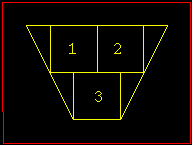
- Sub Block
- Equivalent to Sub Cell.
- Sub Cell
- Smaller cells that together form a parent cell. Sub cells model the geometry of the geological boundaries more closely. The sub cell size must divide into the parent cell size as an integer.
- Substitute
- Search and replace.
- Suffix
- A number of characters following a (file) name.
- Super Elevation
- Super elevation is the amount of camber or sideways inclination that the road surface undergoes when passing around horizontal curves. The super elevation is applied to each side of the road independently, usually determined by a super elevation diagram.
- Survey.codes
- A file that contains the object name for the string or point (for example crest, toes), group name, feature name, colour, line type, points or lines.
- Survey Station
- A surveyed point used by surveyors for future reference.
- Syncline
- A syncline is a fold in rocks in which the layers are bowed downward, resulting in a bowl-shaped structure. The younger rocks are towards the centre of a syncline.
- T -
- Tabular
- (a) Said of a feature having two dimensions that are much larger or longer than the third, such as an igneous dike, or of a geomorphic feature having a flat surface, such as a plateau.
- (b) Said of the shape of a sedimentary body whose width/thickness ratio is greater than 50 to 1, but less than 1000 to 1 (Krynine, 1948, p. 146); e.g. a graywacke formation in a geosynclinal deposit.
- (c) Said of a sedimentary particle whose length is 1.5-3 times its thickness (Krynine, 1948, p. 142).
- (d) Said of a crystal form that shows one dimension markedly smaller than the other two.
- (e) Said of a metamorphic texture in which a large proportion of grains are tabular and have approximately parallel orientation (Harte, 1977).
- Tadpole
- A tadpole plot, which is also known as a 'vector plot', plots the dipmeter or drift results where the true dip angle is plotted versus depth as the displacement of a dot. A line segment points from the dot in the direction of dip using the usual map convention of north being at the top.
- Tailings
- Those portions of washed or milled ore that are regarded as too poor to be treated further, as distinguished from the concentrates, or material of value.
- Template
- A pattern or guide built to various designs, for example a drilling template used to ensure cut holes in development are drilled to a standard design.
- Ternary Plot
- This plot type produces a triangle graph of three variables. Each variable is represented as being a percentage of the sum of the triplet data. All three variables must have the same number of values. Points near one corner of the triangle indicate that one variable is predominant in the three variables. Points near the centre of the triangle indicate samples in which the three components are in roughly the same proportion.
- Terrace Mining
- A mining method that involves the creation of horizontal and near-horizontal benches to access the mine. Usually in open cut coal mines where the coal seams are steeply dipping.
- Terrain
- The terrain forms the basis of the surface on which the road is designed. In the Iroad module the terrain is a triangulated surface and this must be present for the design to proceed. The terrain may be generated from a number of sources, such as digitising of maps, surveying of landscape or photogrammetry.
- Tetrahedron
- A crystal form in cubic crystals having symmetry 43m or 23. It is a four-faced polyhedron, of which each face is an equilateral triangle.
- Text Objects
- Text objects consist of lines of text data used primarily for annotation. Each block of text is defined as one object.
- Texture Mapping
- Draping a texture map (image) over a triangulation.
- Throw
- Vertical distance between a stratigraphic horizon on one side of a fault and the same horizon on the other side as seen in a vertical cross section drawn at 90 degrees to the fault plane.
- Ticket
- A sample.
- Tie In
- In geophysics, the relating of a new station or value to those already established.
- Tie Lines
- Digitised objects used in three dimensional triangulations that join adjacent polygons and force the triangulation function to follow a defined routine.
- Time Series
- A sample of data values collected at equally spaced points in time. Possible autocorrelation between adjacent values makes it necessary to use special statistical methods to analyse this type of data.
- Tiled Texture Resources
- Texture resources that are repeated to fill a triangulation surface.
- Toe
- The junction of a face with the floor of an excavation.
- Toolbars
- Bars containing a series of icons that instigate operations concerning your view of the data, changing various defaults or providing shortcuts to frequently performed actions. Refer to Toolbars in the Workbench documentation.
- Topography
- (a) The general configuration of a land surface or any part of the earth's surface, including its relief and the position of its natural and man-made features. See also geomorphy.
- (b) The natural or physical surface features of a region, considered collectively as to form; the features revealed by the contour lines of a map. In nongeologic usage, the term includes man-made features (such as are shown on a topographic map).
- (c) The art or practice of accurately and graphically delineating in detail, as on a map or chart or by a model, selected natural and man-made surface features of a region. Also, the description, study or representation of such features.
- (d) Originally, the term referred to the detailed description of a particular place or locality (such as a city, parish or tract of land) as distinguished from the general geography of a country or other large part of the world, and also the science or practice of such a description; this usage is practically obsolete.
- Topology
- (a) Study of the properties of geometric configurations. In digital cartography, it is concerned with the characteristics of data that describe the spatial relationships, such as dimensionality, adjacency and connectivity, of map elements to each other.
- (b) The spatial relationships among invariant points, univariant lines, and divariant fields in a phase diagram.
- Toppling Window
- The area of a stereonet that defines angles whereby toppling failure is likely. A toppling failure occurs when a load of rock overturns because it is inclined steeply into the pit wall or hillside. It is called toppling because the rock falls from the crest, not the toe of the rock formation.
- Transformation Matrix
- A rectangular array of numbers set out in rows and columns in order to transform, for example, co-ordinates.
- Translate
- In the context of "translating an object" it means "copying" or "moving" an object.
- Transmissivities
- Groundwater term. The extent to which a body or medium transmits water.
- Traverse
- A single line of survey stations laid out so that any station is visible to the two adjacent stations.
- Triangle
- That which makes up a triangulation. Triangles are also called facets.
- Triangulation
- A series of three dimensional co-ordinates and links between them such that a series of triangulated planes is determined which, when linked, define a surface or enclose a volume. By using a triangulation structure a representation of surface can be accurately defined in three dimensional space. The triangulation structure can therefore define a two dimensional or topographic surface or be enclosed such that a three dimensional or solid is represented by the data. Triangulations accurately represent the observed data points since each data point is preserved in the resultant triangulation structure. Breaklines that represent such features as faults, pit toes and crests are followed exactly. See also Valid Triangulation.
- Trifications
- Triangle sides with three neighbours.
- U -
- Unconformable
- Said of strata or stratification exhibiting the relation of unconformity to the older underlying rocks; not succeeding the underlying rocks in immediate order of age or not fitting together with them as parts of a continuous whole. In the strict sense, the term is applied to younger strata that do not "conform" in position or that do not have the same dip and strike as those of the immediately underlying rocks. Also, said of the contact between unconformable rocks.
- Unconformity
- (a) A substantial break or gap in the geologic record where a rock unit is overlain by another that is not next in stratigraphic succession, such as an interruption in the continuity of a depositional sequence of sedimentary rocks or a break between eroded igneous rocks and younger sedimentary strata. It results from a change that caused deposition to cease for a considerable span of time, and it normally implies uplift and erosion with loss of the previously formed record. An unconformity is of longer duration than a diastem.
- (b) The structural relationship between rock strata in contact, characterised by a lack of continuity in deposition, and corresponding to a period of nondeposition, weathering or especially erosion (either subaerial or subaqueous) prior to the deposition of the younger beds, and often (but not always) marked by absence of parallelism between the strata; strictly, the relationship where the younger overlying stratum does not "conform" to the dip and strike of the older underlying rocks, as shown specifically by an angular unconformity.
- Underlays
- In Vulcan software terms, entities that form part of the screen display but that cannot be edited by any of the standard design functions. Underlays cannot be selected as an object nor can they be saved to a design database. Triangulation models, block model blocks and slices, plot extents and labels are all examples of underlays. Coordinate grids are also considered to be an underlay though they, along with legends and rotation axes, are more accurately classified as 'overlays'.
- In mining terms, an underlay is the extension of a vein or ore deposit beneath the surface; also, the inclination of a vein or ore deposit from the vertical, that is Hade.
- Unify
- Uniting, for example, unite a number of objects to form one object. The unified objects are created in a new layer.
- Univariate Statistics
- Equivalent to General Statistics.
- Unselect
- Remove.
- User Menu
- This type of menu can be set up by the user by selecting options from existing menus. Thus users may create their own menu of favoured options.
- V -
- Valid Triangulation
- A valid triangulation must satisfy two conditions: Proper Intersection and Proper Topology.
- Proper Intersection
For proper intersection it is required that for each pair of facets, they are not connected or that they have a single vertex in common or that they have two vertices and the edge joining them in common. - Proper Topology
For proper topology each facet contains three edges. Each edge connects two vertices and for each edge of a facet it is required that it is unique (no other facet contains an edge that connects the two vertices connected by that edge) and it is identical (connects the same two vertices) to one and only one other edge in the triangulation. Note that the first condition does not apply to solid triangulations as they are always closed. Any edge that is part of more than two facets in a triangulation is referred to as a topological inconsistency. - Variable Pairs
- Data variables that are plotted against each other. For example, selecting variables AU and AG for the horizontal axis and variables
- Variance
- Variance, denoted by s2, is a measure of the dispersion of data about the mean of an interval-level variable. This statistic is one way of measuring how closely the individual scores on the variable cluster around the mean. Mathematically, it is the average squared deviation from the mean.
- Variography
- Calculation of experimental variograms and subsequent fitting of appropriate variogram models.
- Vein
- A clearly defined mass of ore, mineral.
- Veneer
- (a) A thin but extensive layer of sediments covering an older geologic formation or surface; for example a veneer of alluvium covering a pediment.
- (b) A weathered or otherwise altered coating on a rock surface, for example desert varnish.
- Vertex
- The point of intersection of two sides of a plane figure or angle.
- Vi
- A text editor for the SGI UNIX operating system.
- Virtual Folder
- A folder created by the software for viewing purposes. It groups files based on similarity or file extension. The virtual folder does not physically exist on the system. For example, the Workbench Explorer application shows block model files (
.bmf) in a folder named Block, image files (.rgb,.pexel,.gif) in a folder named Images but physically the files are located elsewhere.
- W -
- Wall
- In mining terms, the side of an orebody. The overhanging side, if the orebody is inclined, is known as the hanging wall and the lower side as the footwall. In Vulcan also used to indicate a subset of a triangulation bounded by edges (triangle edges with no neighbours) or trifications (edges with three or more neighbour triangles). Internal walls may occur as a result of appending triangulations.
- W Tag
- A parameter that can be assigned to a coordinate point to hold any other type of numeric information. E.g. point number or, in underground mine design, the survey station number.
- Waste
- Barren rock outside an orebody. Also known as country rock or mullock.
- Wellbore
- Equivalent to Borehole.
- Well Conditioned
- This varies in different situations, but it is usually a case of ensuring the triangles are all roughly the same size and that there are no really small internal angles. (that is< two degrees).
- Wire Extensometer
- A stationary monitor. The XYZ positions do not change for each time interval. Wire extensometers are used for recording strain and elongation measurements.
- Wire frame
- The structure made up of triangles to simulate the shape of a two dimensional or three dimensional item.
- Workbench
- The Graphical User Interface (GUI) used by the Vulcan product suite.
- Workings
- A general term meaning all the underground openings of a mine. In Vulcan, workings are put into a layer.
- Wulff Net
- (a) A coordinate system used in crystallography to plot a polar stereographic projection with conservation of equal angles, such as for plotting angular relations obtained from universal stage measurements.
- (b) Stereonet - Named after
- X -
- X
- Individual point or line of text in the object. Each point or text line may be independently edited. Each coordinate point in a string object has a set of three values: X, Y, Z. The X, Y, Z values correspond to the X and Y axes respectively (or Easting/Northing, Latitude/Longitude depending on the coordinate system being used). The Z value corresponds to the Z or Level Axis.
- Y -
- Y
- Individual point or line of text in the object. Each point or text line may be independently edited. Each coordinate point in a string object has a set of three values: X, Y, Z. The X, Y, Z values correspond to the X and Y axes respectively (or Easting/Northing, Latitude/Longitude depending on the coordinate system being used). The Z value corresponds to the Z or Level Axis.
- Z -
- Z
- Individual point or line of text in the object. Each point or text line may be independently edited. Each coordinate point in a string object has a set of three values: X, Y, Z. The X, Y, Z values correspond to the X and Y axes respectively (or Easting/Northing, Latitude/Longitude depending on the coordinate system being used). The Z value corresponds to the Z or Level Axis.
- Zonal Anisotropy (Stratified Anisotropy)
- Where there are high and low values. The variability in the direction parallel to the direction of zonation might be significantly lower than in the direction perpendicular to zonation.
- Zoom
- To magnify a screen image.
Was this page helpful?
